Be Ready Checklist: 3 Days of Supplies the UK Wants at Home
On October 22, Wes Streeting presented the UK government’s new Be Ready campaign and its Be Ready checklist. The message was simple: keep enough food, water and cash at home to last three days. The headlines ranged from “stockpile advice” to “scaremongering,” so I read the official Be Ready page and the news coverage side by side.
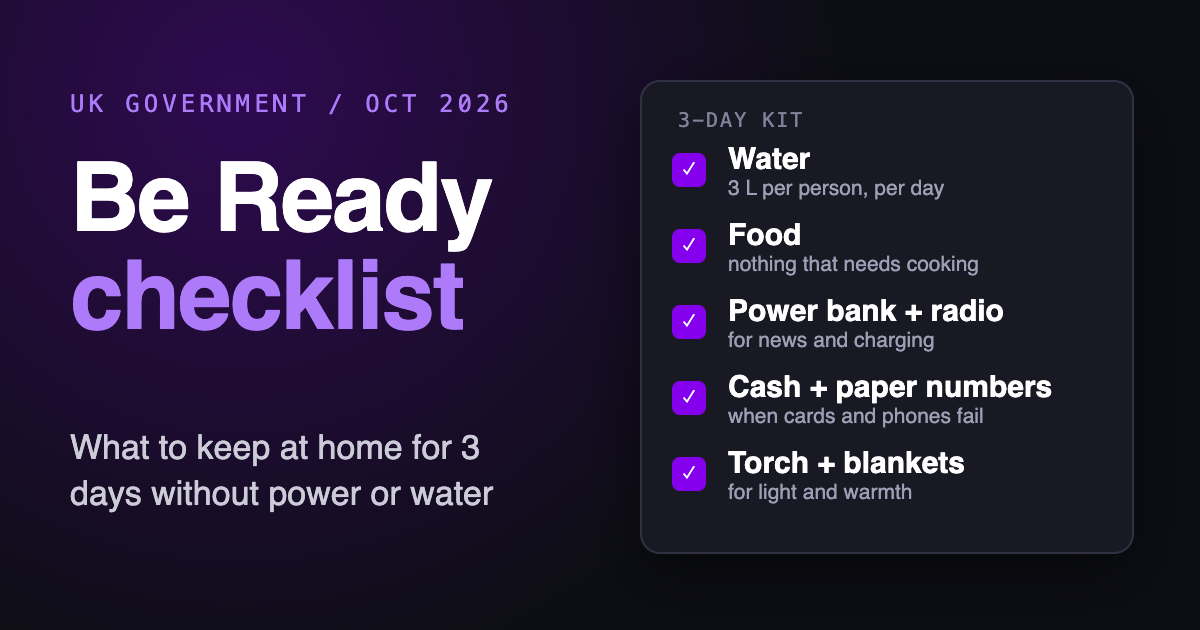
Here’s the short version: nobody is asking you to empty the supermarket shelves. The government describes a basic three-day kit that most homes can build slowly. Still, a few items on the list are easy to forget, so it’s worth going through it once.
What did the UK government announce?
According to The Independent, Be Ready marks the start of a three-year drive to get households ready for disruption. Streeting, whom the paper describes as Defence Secretary, presented updated advice on threats such as flooding and wildfires. The paper also lists cyber attacks among the risks. Besides the advice, a new website at beready.campaign.gov.uk hosts a downloadable checklist.
The kit is meant for a short incident of about three days, such as a power failure or a water supply problem. The government says three days matters because it helps households cope while support reaches the people who need it most. Streeting also told people to stay “alert not alarmed.”
However, not everyone liked the tone. One headline I saw quoted critics who warned that everyone would panic buy. That worry is fair. Yet the official page says the opposite: build the kit gradually and pick up an extra item or two on regular shopping trips.
The Be Ready checklist at a glance
| Category | What to keep | Detail from the guidance |
|---|---|---|
| Water | Bottled water for 3 days | 3 litres per person per day for drinking, with more for cooking and washing |
| Food | Non-perishable food for 3 days | Nothing that needs a fridge or cooking, such as tinned meat, fish and vegetables, dried fruit and nuts |
| Hygiene | Hand sanitiser, wet wipes, bathroom products | Useful when the water is off |
| Light and warmth | Torch with spare batteries, blankets, sleeping bags, warm clothes | Torches are safer than candles, and homes cool down fast without heating |
| Communication | FM radio (battery or wind-up) and a charged power bank | Write down the frequencies of the stations you use |
| Money and documents | Cash in coins and notes, cards, copies of IDs, key phone numbers | Cards and ATMs may not work during an outage |
| Medical | First aid kit and essential medication | Request repeat prescriptions up to 5 working days before you need them |
| Baby | Ready-to-feed formula, nappies, wipes | Powdered formula needs safely boiled water |
| Pets | Pet food and bottled water | Plan for your animals too |
The Be Ready checklist on the official page has nine categories, which probably explains the “nine items” in many headlines. Either way, the content matches across both sources.
Water: the math is simple
Three litres per person per day over three days comes to 9 litres per person. For a household of four, that means 36 litres, or six 6-litre bottles. However, the government calls the 3 litres a drinking amount only. Cooking and washing need more, so I’d treat 36 litres as a floor and not a target.
Food: nothing that needs cooking
For the Be Ready checklist, the key phrase is food with a long shelf life that needs no refrigeration or cooking. Tinned meat, fish and vegetables all qualify, and so do dried fruit and nuts. The guidance also says to buy food you usually eat. That makes sense, because a pile of tins nobody likes will just sit there. Also, The Independent reminds readers to add a tin opener.
Rice and pasta show up in some nutritionist lists that the paper quotes. Still, both need heat and water, so they only help if you can still cook. In a real power cut, I’d lean on the tins first.
The easy-to-forget items
The power bank, the radio and the cash are the three items I’d double-check. Streeting asked what people would do if they lost access to online banking or had a power cut, and cash answers the first question directly. Meanwhile, a wind-up radio keeps news coming when phone networks are busy or your battery is gone.
Then there are the paper items. The guidance asks you to write down important phone numbers, a list of regular medication and doses, and the numbers to report a power cut. Those are 105 in England, Scotland and Wales, and 03457 643643 in Northern Ireland. A dead phone can’t show you any of that, so a printed sheet in the kit is worth ten minutes.
Why is the government pushing this now?
The Independent points to several threads. First, the government has updated its national risk register, which is a planning tool and not a prediction. Second, the UK went through record heatwaves and drought this summer. Analysts at Shore Capital warned that five back-to-back heatwaves could hurt harvests and lead to Britain’s worst food security crisis in decades. The National Farmers Union called the situation “increasingly concerning.”
I’d keep those two threads apart. The farming concerns come from named analysts and a farmers’ union. In contrast, the cyber and security threats are described in broader terms, and the government’s own page doesn’t give a date or a specific event. For a reader, the practical conclusion is the same: a power cut or a supply hiccup can happen for many reasons, and three days of basics covers all of them.
How I would build the Be Ready checklist kit without overspending
The government itself says to go step by step. This is the order I’d follow after reading the whole Be Ready checklist.
- Check your cupboards first, because you probably own more of the list than you think.
- Buy the cheap, one-time items next: a torch, spare batteries, a power bank and a radio.
- Add a few bottles of water and a few tins to each regular shop until you hit your household’s number.
- Print the paper items: phone numbers, medication list, copies of IDs and the 105 number.
- Store everything in one spot that you can find in the dark.
- Set a reminder for six months from now to check expiry dates.
Quick answers
Do I have to follow the Be Ready checklist?
No. The page is advice, and it says plainly that some people will only follow a few steps. Besides, the government frames it as something to build gradually.
How much water do I need?
Plan on at least 3 litres per person per day for drinking. Over three days, that’s 9 litres per person, and extra water is needed for cooking and washing.
Does this apply outside the UK?
The numbers and phone lines come from UK guidance. However, a three-day kit for a power or water outage works in most places, so check your own local authority for specifics.
How often should I check the kit?
The guidance suggests a reminder every six months. Then swap out anything close to its expiry date and update the kit if your household has changed.
The short version
The UK government’s new Be Ready campaign asks households to keep three days of water (3 litres per person per day), food that needs no cooking, cash, a power bank and a radio. You can build the kit slowly, and the guidance says to check it every six months.