Crime Stoppers Data Breach: What Tipsters Should Do Now
The whole point of an anonymous tip line is that nobody finds out who called. This week the Crime Stoppers data breach put a dent in that promise, and I spent a few hours reading the coverage to work out what is actually proven.
Here is the gist. A hacktivist group says it stole millions of tips from the company behind the software that many Crime Stoppers programs use. Reporters have checked parts of that data, but the company hasn’t confirmed how bad it is. Meanwhile, Toronto Crime Stoppers has stopped taking tips, and several Canadian police forces have stepped back from the service too.
What happened in the Crime Stoppers data breach
The software is called P3. It comes from P3 Global Intel, a Texas company owned by Navigate360. According to Straight Arrow News, its customers include Crime Stoppers programs, local and federal police, public schools and the U.S. military. So a lot of “anonymous” forms sit on the same platform.
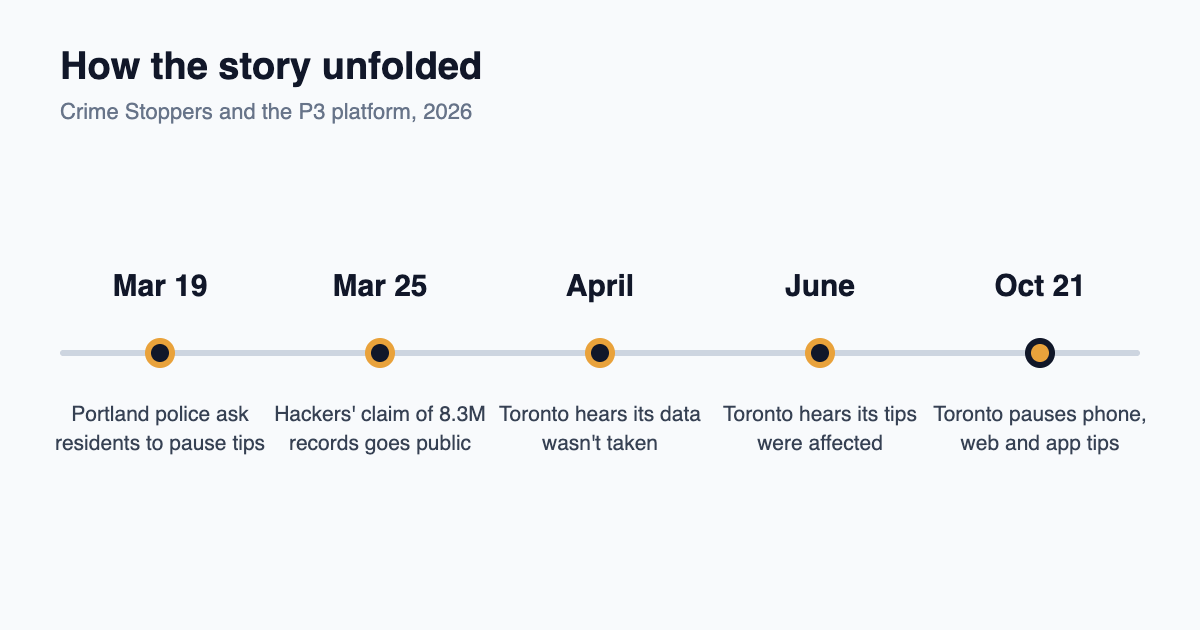
In March, a group calling itself the Internet Yiff Machine gave the data to Straight Arrow News, and the nonprofit Distributed Denial of Secrets got a copy too. Malwarebytes reported it on March 25. Navigate360’s CEO told reporters the company had hired a forensics firm and had “not confirmed that any sensitive information has been accessed or misused.”
After that, the story moved slowly. Toronto Crime Stoppers heard in April that its data was safe, then heard in June that it wasn’t. It paused tip-taking on October 21, days after CBC published its own investigation.
What is confirmed and what is not
Most of the early headlines mixed hacker claims with verified facts. Therefore I sorted them.
| Claim | Status |
|---|---|
| 8.3 million records dated 1987 to November 2025 | Claimed by the hackers and reported by Straight Arrow News. Navigate360 hasn’t confirmed it. |
| The data is real | Reporters say they confirmed parts of it by contacting people in the records. |
| Toronto’s tips are in it (176,859, from January 2022 to November 2025) | Yes. Navigate360 told Toronto Crime Stoppers so. |
| More than 1.5 million Canadian tips leaked | CBC’s finding. Global News says it did not verify the number. |
| Names, addresses and Social Security numbers of people named in tips | Reported, if the data is genuine |
| Tip-tracking IDs and passwords stored in plain text | Reporters say they saw this themselves |
| Tipsters’ own IP addresses are in the data | Unclear. One feature may log them, but no source confirms it for the Canadian tips. |
| Whether the 14,973 names in Toronto’s list are tipsters | Unknown |
That last row is the one I keep staring at. If those names are people who were reported, that is one kind of problem. If they are the people who called in, it is a much worse one, and right now nobody outside Navigate360 can say which.
Why Canada is in the headlines this week
According to Global News, 12,392 of Toronto’s affected tips may contain personal information. Toronto Crime Stoppers normally removes identifying details before it passes a tip to investigators. However, some of the stolen tips are original versions, so those details may still be in there.
Police reacted quickly. Toronto, Halton, Peel, York, Hamilton and Kingston have suspended their use of the service or announced they will. CP24 adds that Durham removed its public links to it. Toronto Crime Stoppers chair Sean Sportun said it plainly: “Until we have a safer way to protect you, please do not send us tips by phone, online or through the app.”
In my view, the timing is the hard part. The first reports came out in March, and many Canadian tipsters probably only learned about it this month. In that gap, people kept using forms that they believed were anonymous.
Should you worry about the Crime Stoppers data breach?
If you sent a tip
You can’t check whether your tip is in the data, and no public tool exists for it. So ask what you wrote instead. Did you give a name, phone number or email? Maybe you explained how you know the person, or attached a photo, which can carry location data. Any of those can point back to you even if the form never asked who you are.
Also think about the tracking ID and password you got after submitting. If you reused that password anywhere else, change it now.
If your name might have been in a tip
Straight Arrow News says some records include dates of birth, addresses and Social Security numbers. If you live in the U.S. and think that could be you, a credit freeze is free and takes a few minutes. Then watch your credit reports for accounts you didn’t open.
If you need to report something today
For an emergency, call 911. Otherwise, contact your local police directly, though that route isn’t anonymous. Portland police, for example, gave an email address for non-anonymous tips back in March. I couldn’t find an official replacement for fully anonymous tipping, and that gap is the real loss here.
A checklist for this week
- Pause. Don’t use your local Crime Stoppers site or app until the program says it is safe.
- Write down what you sent. Knowing what you shared lets you judge your own risk.
- Change reused passwords. Start with any that match a tip password, and turn on two-factor login.
- Ignore requests for your tip number. Toronto Crime Stoppers says it never asks for one, so treat those messages as scams.
- Talk to police if you fear retaliation. Standard fixes like new passwords won’t solve that problem.
What I would check before trusting any anonymous tip form
After this Crime Stoppers data breach, one thing is clear to me. An anonymous service is a promise, and from the outside you can’t audit it. Straight Arrow News notes that P3 had claimed its tools were never breached in 20 years. That line sounds reassuring, but it only held until it didn’t.
So I would ask three things first. Who runs the platform behind the form? Does the page say what it logs, such as your IP address? And do I need to give any contact details at all? Switching channels isn’t a fix either, because Toronto paused its phone line along with the web form and the app.
Navigate360 still hasn’t released a full report, so I’ll keep watching for one. Until then, I would treat “anonymous” as “confidential, at best.”
The short version
Hackers say they took millions of tips from P3, the platform behind many Crime Stoppers lines, and reporters have verified parts of the data, but the full scope isn’t confirmed. If you ever sent a tip, think about what identifying details you included, change any reused tip password, and use 911 or direct police contact until your local program says its line is safe.