Bank of Canada Rate Hike on Oct 28? What It Means for You
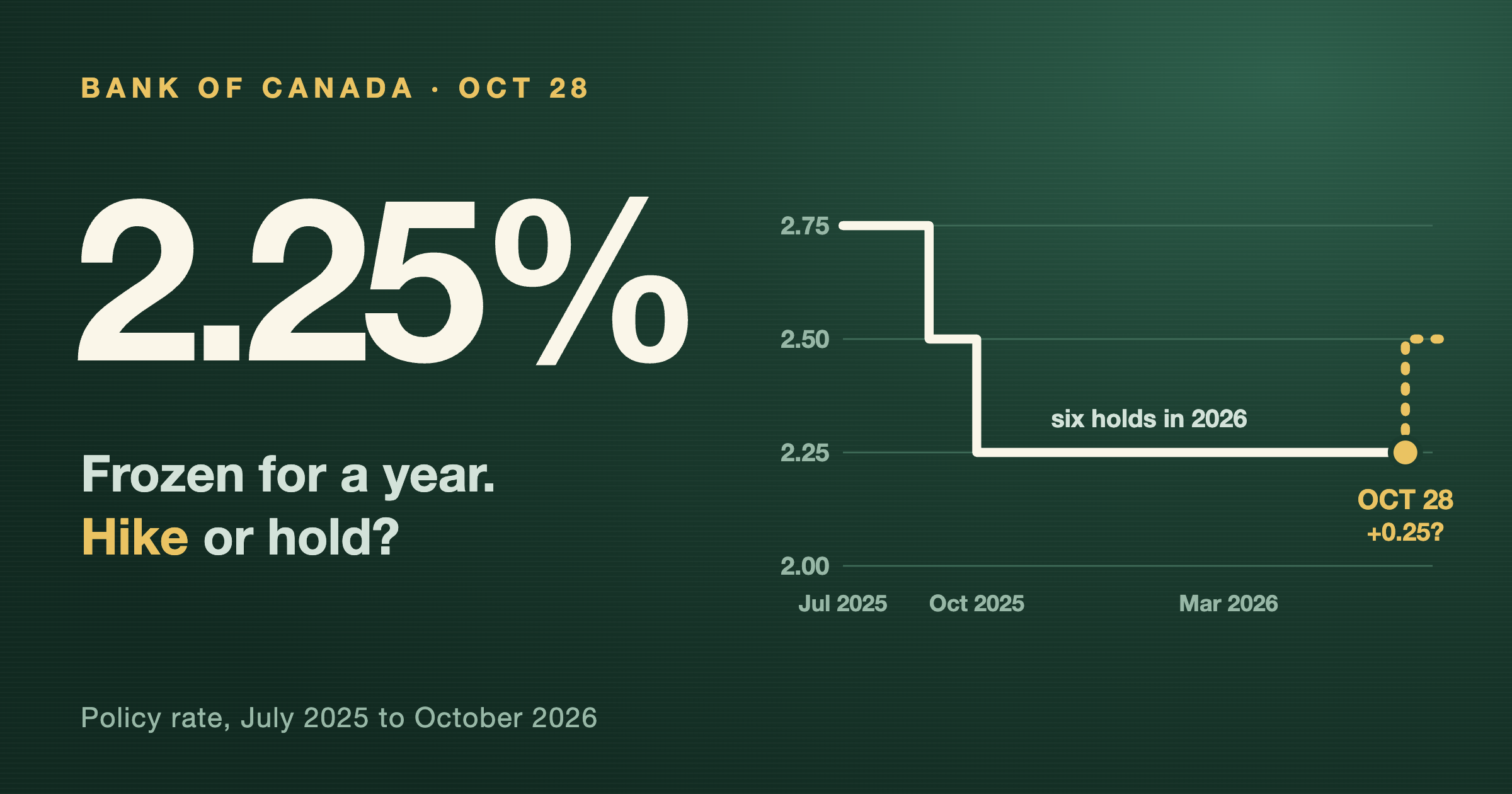
I opened the Bank of Canada’s rate table this morning, and the number hasn’t moved since October 2025. It still sits at 2.25%. On Wednesday, October 28, that could change, because several economists expect a Bank of Canada rate hike of 0.25 points. It would be the first hike in more than three years.
I read Global News’ preview, CIBC’s note and the Bank’s own schedule, then ran the numbers on a sample mortgage. Here is where I landed. A hike is likely but not locked in, and variable-rate borrowers feel it first. So it pays to know which kind of loan you have before Wednesday.
What we know about the Bank of Canada rate hike
I started with the confirmed facts, which come straight from the Bank’s policy rate page and from RBC’s prime rate table.
| Item | Where it stands |
|---|---|
| Policy rate | 2.25% |
| Last change | A 0.25-point cut on October 29, 2025 |
| 2026 decisions so far | Six holds in a row, from January to September |
| Next decision | Wednesday, October 28, with a Monetary Policy Report |
| Big-bank prime rate | 4.45% (RBC’s table, updated October 23) |
Nothing is official until the announcement. Everything below about a hike is a forecast, not a decision.
Why economists expect a Bank of Canada rate hike
Two things changed the mood. Gas prices pushed inflation up, and the governor started talking differently.
Gas prices pushed inflation back above 3%
September inflation came in at 3.1%, mainly because of higher gas prices. That is the third month in a row at or above 3%. Global News ties the energy jump to the Iran war. The Bank’s last forecast, from July, had inflation cooling to about 2.5% in the second half of this year. That forecast already looks out of date.
What the governor and the banks said
In August, Governor Tiff Macklem said that if energy prices stay high, “there could well be a need to increase the policy rate to get inflation back to two per cent.” Then he spoke in Bangkok at the IMF meetings and asked whether inflation would fall on its own or whether the Bank would have to raise rates. Several forecasters changed their calls after that.
- Scotiabank (Derek Holt) forecasts a 0.25-point hike next week.
- Desjardins (Randall Bartlett) expects a hike in October and another in January.
- BMO (Robert Kavcic) is looking for “a very cautious set of rate hikes.”
- CIBC sees “rising odds of a rate hike this month.”
Why it is not a sure thing
Core inflation, which strips out food and energy, has stayed close to 2% for several months. CIBC admits that recent core inflation and jobs data lean the other way. Producer prices also jumped 13.5% in August from a year earlier, but CIBC says only about a quarter of core inflation is tied to them. So the Bank would be acting on what might happen, not on what already did. To me that sounds more like insurance than an emergency. Still, I can see why it would rather move early than late.
What a Bank of Canada rate hike costs on a $400,000 mortgage
When the Bank moves, the big banks usually follow with prime. After the October 2025 cut, RBC changed its prime rate one day later. Variable-rate mortgages and lines of credit are priced off prime, so a 0.25-point hike would take prime from 4.45% to 4.70%.
I used a $400,000 balance, a 25-year amortization and a 4.45% rate as a round example. Your rate is probably prime plus or minus a little, so your numbers will differ slightly.
| Scenario | Rate | Monthly payment | Change |
|---|---|---|---|
| Today | 4.45% | $2,212 | n/a |
| One hike (October) | 4.70% | $2,269 | +$57 |
| Two hikes (October and January) | 4.95% | $2,327 | +$115 |
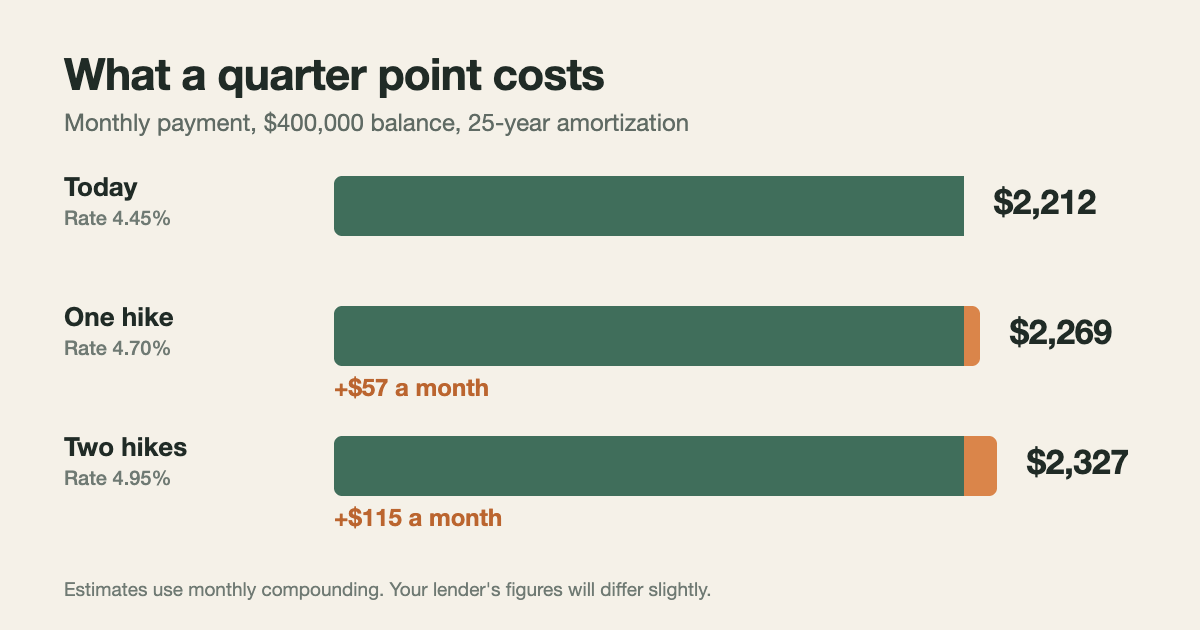
Here is the rule of thumb I took away. A quarter point costs about $14 a month for every $100,000 borrowed on a 25-year mortgage. On a $50,000 line of credit, it adds roughly $10 a month in interest. The $57 on our example adds up to about $684 over a year. That stings, but it won’t break most budgets. Three or four hikes in a row would be a different story.
Which loans does the Bank of Canada rate hike hit?
This is the part most previews skip. Not every loan reacts the same way.
| Your loan | What happens after a hike |
|---|---|
| Variable mortgage with adjustable payments | The payment goes up soon after prime changes. |
| Variable mortgage with fixed payments | The payment stays put, but more of it goes to interest. |
| Fixed-rate mortgage | Nothing until renewal. Then a higher rate means a higher payment. |
| Line of credit or HELOC | The interest cost rises with prime. |
| Fixed-rate car or personal loan | Your current rate stays. New loans cost more. |
If your payment is fixed, check your trigger rate
This is the one that worries me most. With a fixed-payment variable mortgage, a hike doesn’t change what you pay. It quietly changes what the payment does. The Financial Consumer Agency of Canada warns that rising rates shift more of each payment to interest, which can leave your balance growing. It tells borrowers to find the trigger rate in their agreement.
Here is what that looks like in my example. Keep paying $2,212 a month on the $400,000 balance. One 0.25-point hike stretches the payoff from 25 years to about 26.3 years. Two hikes push it to about 27.7 years. The trigger rate for that payment is around 6.6%, so you are far from the cliff. The cost simply shows up later, in extra years, and not on this month’s statement. That is my math, not the Bank’s or your lender’s.
What I would do before the Bank of Canada rate decision
- Find your mortgage type. Your lender’s app or statement says whether payments are adjustable or fixed.
- Ask for your trigger rate if your variable payment is fixed. FCAC says to call your lender early if you are getting close.
- Use the quick estimate. About $14 a month per $100,000 for each quarter point on a 25-year mortgage.
- Pay down the highest-interest debt first. That is FCAC’s advice, and credit cards almost always cost more than a mortgage.
- Ask about renewal now if yours is within a few months. Fixed rates follow bond yields more than the overnight rate, so a rate hold may beat waiting.
- Hold off on big moves until Wednesday. Switching or breaking a mortgage can trigger penalties.
What I will watch on October 28
First, the rate itself. Second, the wording about January, since Desjardins expects a second hike then. Third, the Monetary Policy Report, which CIBC says will introduce a new forecasting model called Prima. If the Bank holds instead, your payment stays the same today. Even so, the gas-price pressure doesn’t disappear.
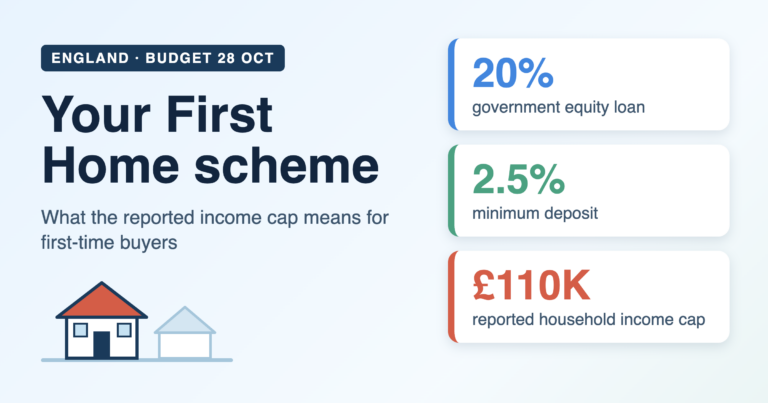
If you follow housing costs in other countries, I also wrote about the UK’s Your First Home scheme and its income cap.
The short version
The Bank of Canada decides on October 28, and some economists expect a 0.25-point hike from 2.25% after inflation hit 3.1% on gas prices. A hike adds about $14 a month per $100,000 on a variable mortgage, while fixed-payment borrowers should check their trigger rate and fixed-rate borrowers feel it at renewal.