Working Holiday Visa Ballot: What Backpackers Should Do
The Australia working holiday visa ballot is the one trending story this week that I could turn into a plan you can use. On Sept. 17, Home Affairs Minister Tony Burke said backpackers who want a second or third year will have to win a draw, and a fresh ABC story this morning shows how hard that landed with the people working wineries and onion fields. I read the minister’s release, the coverage and the Department’s own pages, because the real question is simple: is the regional work still worth it?
Here is where I landed. Yes, the work still counts, but it no longer buys a sure thing. I wrote this on Saturday, Oct. 24, and I flag every spot where the rules are not published yet.
What the Australia working holiday visa ballot changes
Until now, the deal was easy to explain. Backpackers on a Working Holiday (subclass 417) or Work and Holiday (subclass 462) visa did 88 days of regional work in their first year, then got a second-year visa. Six months of work in the second year opened the door to a third. The Department’s specified work page still lists those requirements.
The new plan keeps the work and drops the guarantee. According to InDaily, Burke told the National Press Club: “You will still have to have completed the regional work to be able to be part of those ballots.” The release itself is short, and it says only that the program will “introduce a ballot system for years two and three.”
Here is what the coverage confirms so far:
- Second-year places: capped at 45,000.
- Third-year places: cut to 5,000, down from 31,000.
- Regional work: still required before you can enter the draw.
- Processing: the Department says it is aiming for about three months on most applications.
Home Affairs gave the ABC its reason. A spokesperson said the number of working holiday makers is “at a historically high level” and the changes aim to “manage demand” and support “a fairer allocation of visas.”
Australia working holiday visa ballot numbers, side by side
Numbers help here, so I put them in one table. The “before” figures are the counts of people who met the conditions in the most recent year, as reported by Queensland Country Life and the ABC. Those two outlets name different base years, so treat the exact baseline as approximate.
| Before the ballot | Announced plan | |
|---|---|---|
| Second-year visa | About 57,000 people qualified | 45,000 places in a draw |
| Third-year visa | About 31,000 people qualified | 5,000 places in a draw |
| Regional work | 88 days, then a visa | 88 days, then a draw |
| Third-year work | Six months, then a visa | Six months, then a draw |
What my math says about your odds
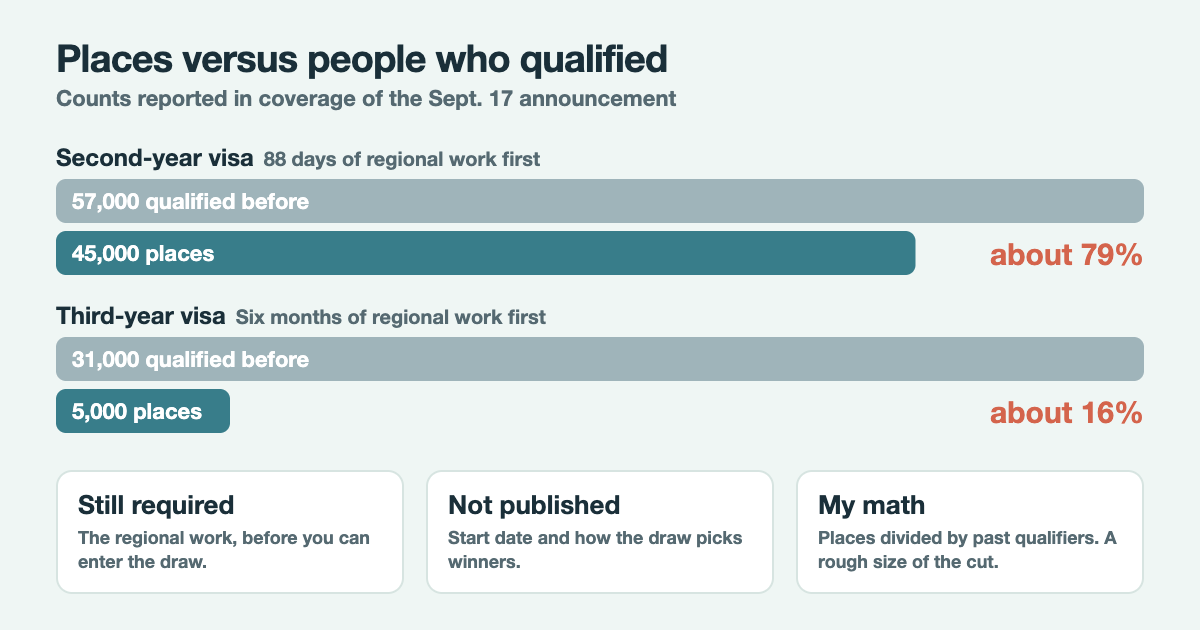
Next, my math. If as many people qualify as last time, 45,000 places for 57,000 qualifiers is about 79 percent, or roughly four in five. For the third year, 5,000 places for 31,000 qualifiers is about 16 percent, or roughly one in six.
However, treat those as rough. Nobody has published how the draw works, and the pool could shrink if fewer people bother with regional work. That is a real possibility, because the people in the ABC story say exactly that. So the percentages describe the size of the cut, not your personal chance.
What is still unclear about the working holiday visa ballot
Several answers are missing, and I would not plan around a guess. First, there is no published start date. The ABC says the changes take effect over the next 12 months, while the law firm Work Visa Lawyers says none has been announced. Second, Queensland Country Life notes that the government “has not yet published the full mechanics” of the ballot, including how selection works.
Third, nobody has said whether people already on a first-year visa fall under the new rules. Also, InDaily reports the package comes without new legislation, which suggests it will run through regulation and ministerial direction. Work Visa Lawyers adds that this means rules can change quickly in either direction.
Finally, do not mix this up with the draw that already exists. The Department’s latest news page describes a separate ballot for China, India and Vietnam passport holders applying for a first subclass 462 visa. Registrations for 2026-27 closed on June 25. That is a different system, and it does not decide your second year.
Should you still do the regional work for the ballot?
This is the question every backpacker in the ABC story is asking. I do not think the working holiday visa ballot has one answer, so here is how I would split it.
If you are already in Australia
Keep going if the work fits your trip anyway. The days still count toward eligibility, and the minister was clear that you cannot enter the draw without them. Besides, no start date exists yet, so nobody can tell you which rules will cover your visa. In other words, quitting now means giving up a chance you may still have.
The ABC piece shows the other side. Irish backpacker Meghan Morris called it “like a lottery system,” and Argentinian backpacker Javier Rodriguez said the extra year the work once earned “is all gone.” Both comments are fair. Still, a chance at a visa is not the same as none, and I would not decide based on a Facebook mood.
If you are planning to come
Plan the first year as a full year, and treat a second one as a bonus. Moreover, the Department says it is normalising processing to about three months and asks you to wait for the grant before booking flights or making work or study commitments, so build that wait into your timeline. Once the visa lands, ticket timing matters too, and my post on holiday airfare shows when prices climb.
If you hold a UK passport
This one is a different case. The Department’s UK page says UK passport holders can get second and third subclass 417 visas without meeting any specified work requirement, for applications lodged on or after July 1, 2024. Work Visa Lawyers reads that as keeping UK holders out of the ballot. I have not seen the Department say so for the new plan, so check its page before you rely on it.
Why farms are nervous about the working holiday visa ballot
The employer side explains why this story is trending. Winemaker Darren De Bortoli told the ABC that backpackers make up 85 percent of his workforce during the three-month vintage that begins in January. Cherry grower Tom Eastlake said losing them could be “catastrophic” for a six-week harvest.
Meanwhile, the people doing the work are weighing the same risk from the other side. If the draw makes regional jobs feel pointless, farms get fewer workers, and the backpackers head for the cities. I think that is the real tension in this policy. The government wants fewer visas, but it still needs the regional work done.
How to protect yourself during your 88 days
Whatever you decide, keep your own paper trail. Save every payslip, contract and message from your employer, because you will need to show your work when you apply. Also, you have the same pay rights as anyone else. The Fair Work Ombudsman says visa holders have the same workplace rights as all other employees, and your visa will not be cancelled if you ask it for help.
On pay, the National Minimum Wage is $26.44 an hour as of July 1, 2026, according to the Fair Work site. An award can set a higher rate for your job, so check which one covers you. Likewise, remember condition 8547, which limits you to six months with one employer unless an exemption applies.
My plan if I were a backpacker right now
If I were weighing the working holiday visa ballot myself, I would do three things. First, keep any regional work that fits the trip, because the draw cannot be entered without it. Second, stop treating the second year as a sure thing in my budget. Third, check the Department’s latest news page every couple of weeks, since the rules are still being written.
I like that the government gave numbers, because numbers beat rumors. Even so, asking people to do months of hard work for a draw feels like a harsh trade, and I would want the rules before I signed up for another harvest.
The short version
Australia’s working holiday visa ballot will decide second and third visas, with 45,000 and 5,000 places, but you still have to finish the regional work first. No start date or draw rules are published yet, so keep your work records, plan your first year as the sure one, and check the Home Affairs latest news page for updates.