Airbnb Checkout Chores Ban: What Changes on November 20
Airbnb checkout chores showed up in the US Google Trends list on October 23, tied to headlines saying hosts can no longer make guests strip beds and wash dishes. Checkout lists that read like a second job are a common complaint, so I wanted to know what really changes. First I read Airbnb’s own policy page, then the coverage from CBC, TechCrunch, Euronews and RNZ. However, the headlines say “banned”, and the policy itself is a bit more nuanced.
The short answer: for reservations booked on or after November 20, 2026, hosts generally cannot ask guests for tasks that take significant effort or time, or that a cleaner would normally do. Also, hosts must show every house rule at booking. Still, the word “reasonable” leaves room, and I think that gap is where the real story sits.
What Airbnb changed about checkout chores
Airbnb rewrote its community policy on house rules and requests. First, the page says hosts may set both, as long as they are reasonable. Then it lists what counts as unreasonable. Here are the main points.
| Topic | What the policy says |
|---|---|
| Start date | Applies to reservations booked on or after November 20, 2026 |
| Chores | No tasks that need significant effort or time, or that a cleaner would typically do |
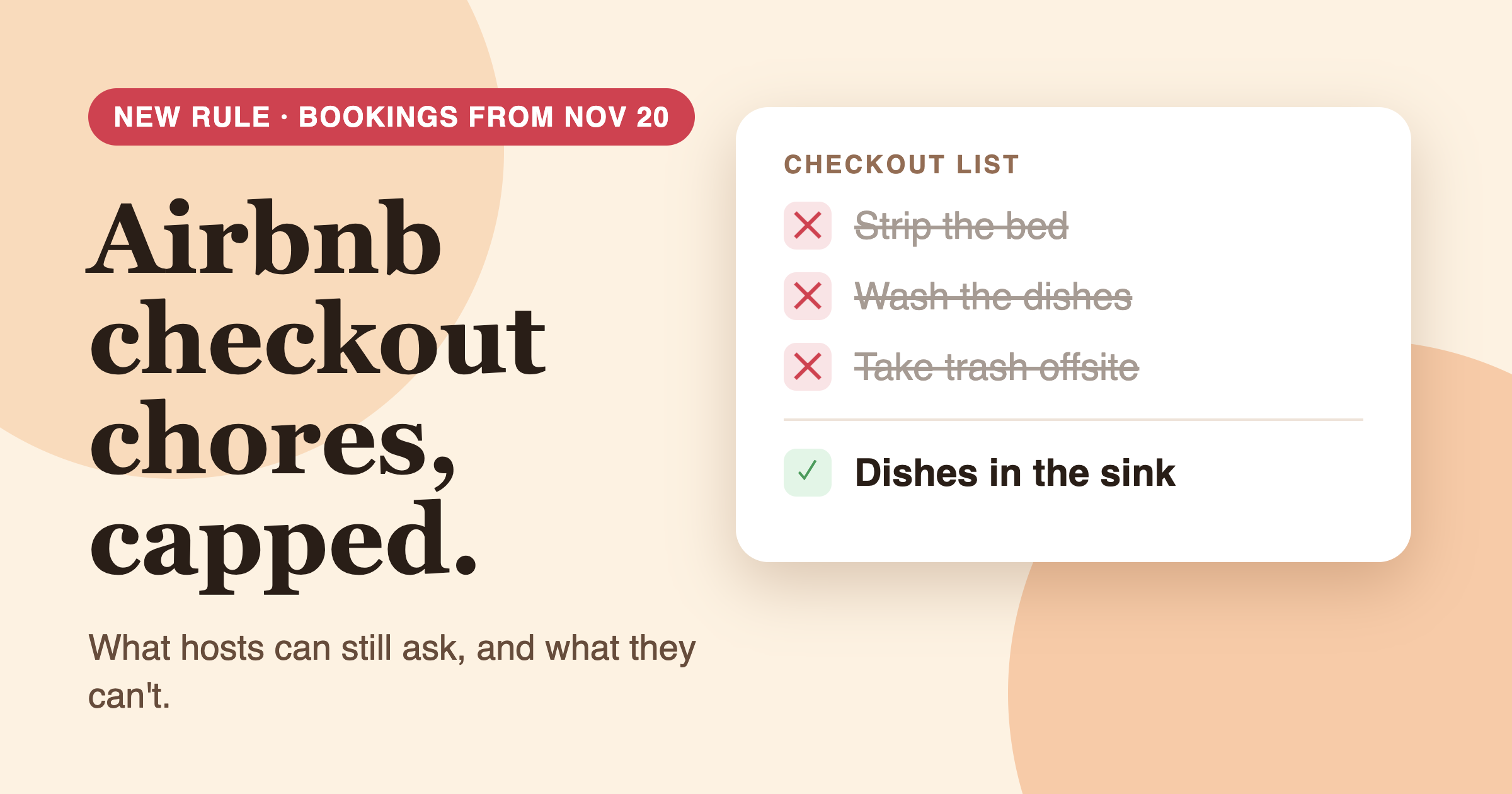
| Examples named | Stripping the bed, taking trash offsite, washing and putting away dishes |
| When rules appear | In the designated section of the listing, visible at booking |
| After booking | No new rules or requests by message, signs in the home or in person |
| Advertised features | Hosts cannot restrict them, and any fee for them must be in the price shown at booking |
| Fines | Hosts cannot impose fines or other penalties on guests |
Which Airbnb checkout chores hosts can no longer require
The policy names three: stripping the bed, taking trash offsite, and washing and putting away dishes. TechCrunch also lists starting laundry. Meanwhile, Airbnb gave one example of what is still fine. In a statement quoted by RNZ, it said hosts should not ask guests to wash and put away dishes, but they can ask guests to put used dishes in the sink.
In addition, CBC reports that the cleaning fee should only cover a basic tidy-up between guests, and that hosts can no longer charge guests for skipping an item on a checkout list.
When the Airbnb checkout chores rule starts
Everything keys off the booking date, not the stay date. Both CBC and the Washington Post give November 20 for new bookings. By that wording, a December stay booked on November 19 would still fall under the old rules. That is my reading of the policy text, so ask Airbnb if it matters for a specific trip.
Airbnb checkout chores: what is off limits and what is fine
Because the headlines blur the line, I sorted the examples from the policy and the news coverage into one table.
| Request | Allowed? | Where it comes from |
|---|---|---|
| Strip the bed | No | Airbnb policy |
| Wash and put away dishes | No | Airbnb policy |
| Put used dishes in the sink | Yes | Airbnb statement (RNZ, Euronews) |
| Take trash offsite | No | Airbnb policy |
| Start a load of laundry | No | TechCrunch |
| Fine for skipping a chore | No | Airbnb policy |
| Limit shower time during a drought | Yes, as a local exception | Airbnb policy |
| Use an animal-proof trash container in bear country | Yes, as a local exception | Airbnb policy |
| Add a new rule by message after booking | No | Airbnb policy |
In other words, the line is effort, not tidiness. Nothing in the policy says guests can leave a mess. Consumer NZ’s Jessica Walker told RNZ that people should leave a place in a reasonable state even if they have paid a cleaning fee. I agree with that, and I think most hosts would too.
Where the Airbnb checkout chores rule is still vague
Airbnb says it looks at the listing type and local context, and it may grant exceptions. Boston University’s Makarand Mody told CBC that he thinks the company left “reasonable” open-ended on purpose, so hosts keep some wiggle room.
Trash is a good example. The policy bans taking trash offsite, while some headlines say taking the bins out. Those are different jobs. Carrying a bag to a bin in the yard takes far less effort than hauling it somewhere else, yet the policy does not say where the line sits. I would not be surprised if the first disputes happen right there.
Light tasks such as locking up or turning off the lights look fine under the wording, since they take little effort. However, Airbnb has not published a full list, so that is my interpretation and not a rule.
Why Airbnb moved on checkout chores now
TechCrunch describes the change as a response to years of backlash over burdensome checkout instructions and hefty fines for not disposing of trash. It also fits a pattern of earlier steps on cost transparency.
| Date | Step |
|---|---|
| 2023 | Airbnb said more than 260,000 hosts had reduced or eliminated their cleaning fees |
| May 2025 | Total prices, including fees but excluding taxes, became the default in search results worldwide |
| October 21, 2026 | CBC, TechCrunch and Euronews reported the new chores policy |
| November 20, 2026 | The policy applies to new reservations |
Seen together, I read this as the third step in the same direction: first the price display, then the fees, now the chores. Guests were never only angry about the cleaning fee. They were angry about paying it and then getting a to-do list. Mody made a similar point to CBC, noting that this is not how travelers experience a hotel.
What hosts say about the Airbnb checkout chores change
Not everyone is happy. TechCrunch points to Airbnb’s community forum, where some hosts argue that basic cleaning duties keep a home sanitary and protect their property. One host with twelve years on the platform wrote that hosts can reasonably expect guests to wash dishes and remove dirty linens, and that the change could make them leave Airbnb.
I understand both sides. A host who turns a home around between back-to-back stays loses real time when a guest leaves wet towels and a full trash can. Still, a rule that surprises people at checkout is a worse deal than a higher nightly price that a host states up front. If a chore is truly part of the stay, I would rather see the host build it into the price and say so at booking.
As for enforcement, Airbnb says it may educate hosts, ask them to update the listing and issue warnings. If a violation persists, the listing can get a notice flagging the issue, lower visibility in search, or other action. Euronews adds that Airbnb will flag requests that do not fit the policy, and the host has to remove them or appeal.
What to do about Airbnb checkout chores before November 20
If you are a guest
| Step | Why it helps |
|---|---|
| Read the house rules section before you book | Hosts have to show rules there at booking |
| Screenshot the rules and the listing page | Hosts cannot add new rules after booking, so a screenshot is easy proof (my tip) |
| Keep leaving the place in a reasonable state | Guests must follow house rules, and Airbnb encourages them to follow requests |
| Report anything that breaks the policy | Airbnb asks guests to contact it about policy violations |
If you are a host
| Step | Why it helps |
|---|---|
| Rewrite your checkout list now | Stripping beds, washing dishes, taking trash offsite and starting laundry are on the wrong side of the line |
| Move every rule into the designated section | Hosts cannot send rules by message, signs or in person after booking |
| Check that the listing is consistent | The policy requires rules to match the rest of the listing page |
| State local reasons clearly | Drought limits or wildlife rules can count as reasonable exceptions |
| Price honestly | If your costs went up, a visible nightly price is safer than a hidden chore (my suggestion) |
Quick answers about Airbnb checkout chores
Do guests still have to follow house rules?
Yes. Airbnb’s ground rules require guests to follow house rules, and repeated or severe violations can bring consequences. Requests are softer, since Airbnb encourages guests to follow them.
Can a host charge me for skipping checkout chores?
Under the new policy, no. CBC reports hosts cannot charge guests for not finishing a checkout task, and the policy bars fines or penalties.
Do cleaning fees go away?
Nothing I read says so. The fee stays, but it should only cover a standard tidy-up between guests.
Does the rule apply to my existing booking?
The policy applies to reservations booked on or after November 20, 2026. Bookings made earlier follow the old rules.
What happens if a host ignores the policy?
Airbnb may educate the host, ask for changes and issue warnings. A persistent violation can lead to a notice on the listing or reduced visibility in search.
Meanwhile, if you are also planning holiday shopping around the same dates, our Walmart Black Friday 2026 guide covers what is confirmed so far.
The short version
Starting with bookings made on November 20, 2026, Airbnb hosts generally cannot ask guests to strip beds, wash dishes or take trash offsite, and they must show every house rule at booking. Meanwhile, “reasonable” is still loosely defined, so screenshot the rules before you book and keep leaving the place tidy.