Holiday Airfare 2026: Why Tickets Cost More and When to Book
Holiday airfare is higher than last year, and the airlines are saying out loud that it won’t drop anytime soon. I read CNN’s report from Friday, the Hopper numbers behind it and a few local news write-ups, because a lot of people still haven’t booked their Thanksgiving or Christmas flights.
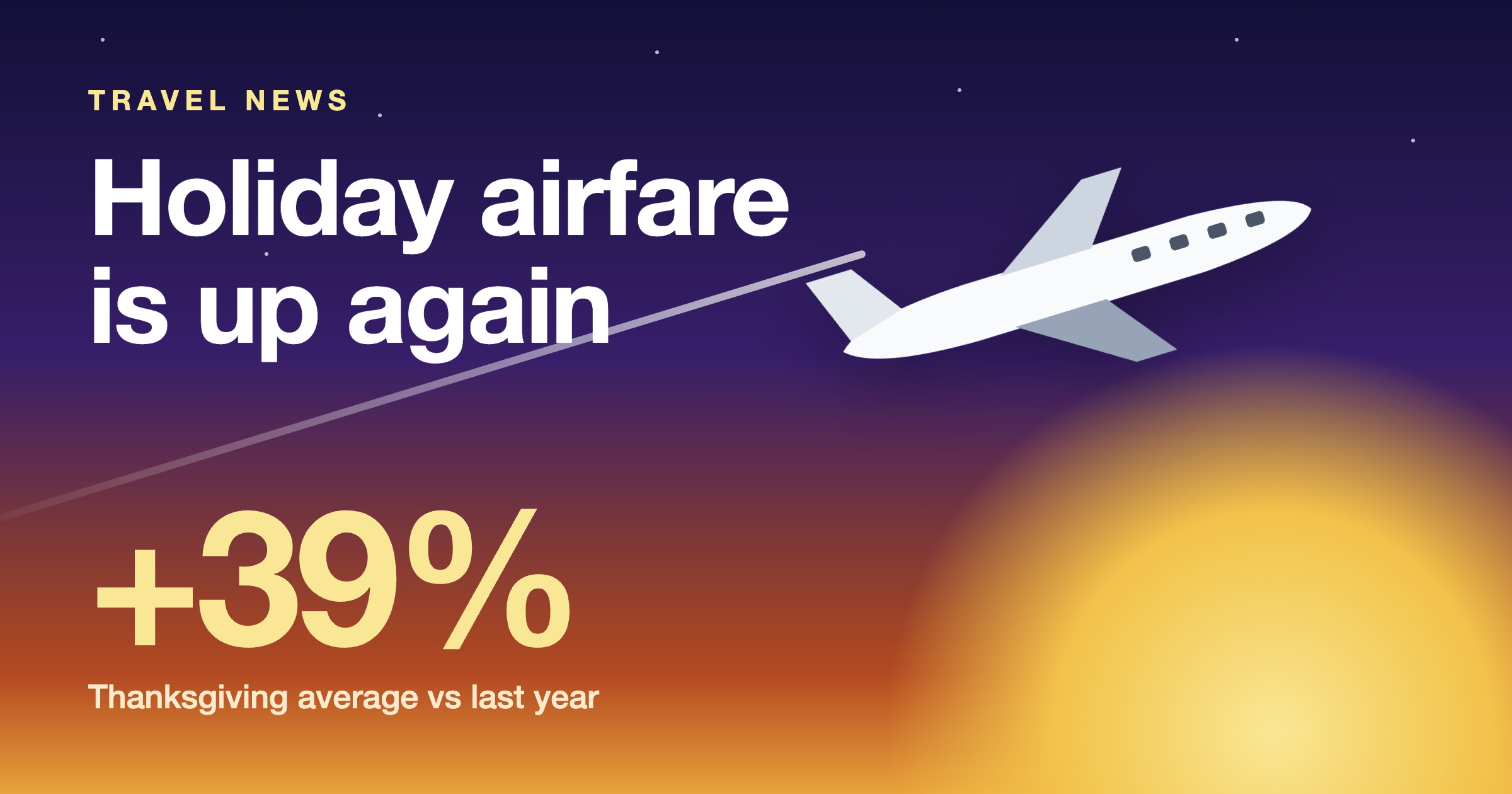
Here is where I landed. Holiday airfare is up 22% to 39%, depending on the holiday, and United’s CEO expects fuel to stay expensive through all of 2027. So I would stop waiting for a price drop and book this week, but there are a few ways to cut the bill. Let me walk through them.
How much holiday airfare has gone up
Hopper has the best snapshot I found. It published a holiday travel report on September 29, and its lead economist Hayley Berg gave CNN a fresh set of numbers on Friday. These are average domestic round-trip prices:
| Holiday | Hopper, Sept 29 | CNN, Oct 23 |
|---|---|---|
| Thanksgiving | $402 (up 31%) | $389 (up 39%) |
| Christmas | $452 (up 23%) | $452 (up 22%) |
One caveat first. Most outlets repeat the same Hopper data, so this is really one source, not five. Still, it’s the only public tracker with this level of detail.
The Thanksgiving row caught my eye. The average fell $13 in three weeks, yet the jump over last year grew from 31% to 39%. If both numbers are measured the same way, last year’s average was roughly $307 in late September and about $280 now. In other words, fares dip in October every year, but this year’s dip is smaller. That’s my math, not Hopper’s.
Hotels barely changed
Hotels are a different story. Hopper puts Thanksgiving stays at $170 a night, which is steady. Christmas stays jump 18% to $197 a night. So if you’re flying for Thanksgiving, the plane ticket is where most of the extra money goes.
Why holiday airfare is not coming down soon
Airlines give three reasons, and I think they are all partly true. However, they don’t carry equal weight.
Jet fuel cost airlines billions more
CNN reports that jet fuel cost more than 60% above last year in the third quarter, which it ties to the war in Iran. United, Delta, American and Southwest spent a combined $6.3 billion more on fuel than in 2025. That works out to about $69 million more per day. KOMO adds that United alone expected to spend $1.8 billion more.
Higher fares and bag fees haven’t covered that gap yet. Airlines expect they will. Meanwhile, United CEO Scott Kirby told investors he assumes fuel stays pricey through 2027, and he said fares could rise even more next year.
Cheap flights quietly disappeared
This is the one most people don’t notice. Airlines cut midweek, Saturday, early-morning and late-night flights. Those are the flights bargain hunters love, and they lose money when fuel spikes. So the cheapest seats didn’t just get pricier. Many of them stopped existing.
Travelers keep paying
Planes are still full, and future bookings are strong. Because of that, airlines feel safe keeping prices where they are. Delta CEO Ed Bastian told investors that fuel started the increase, but customers accepted it, so he calls the new fares “sustainable” even if fuel gets cheaper. Airline writer Zach Griff put it more bluntly: don’t expect airlines to cut fares the day fuel drops.
That Delta line is the one that stuck with me. When a CEO says fares are sustainable even if his biggest cost falls, he is telling you fuel is only half the story. I wouldn’t plan around a rescue sale.
There is one counterpoint. Airlines argue that fares are still cheap once you adjust for inflation and compare them to 2019. That may be true on a spreadsheet, but Griff had a good answer: people don’t compare that way, and they “feel poorer after they pay the credit card bill.”
The fees that come on top of the ticket
A fare is only part of the cost. KOMO reports that United said some flights could add up to $70 for a window or aisle seat, so you can avoid the middle. Bag fees went up too. In April, United raised its first checked bag to about $45 if you prepay and $50 if you pay within 24 hours of departure. A second bag runs about $55 prepaid. United card holders, MileagePlus Premier members, active military and premium-cabin passengers still check a bag free.
Here is a rough example for a family of four flying at the Thanksgiving average, each person with one checked bag, using United’s April prepaid rate. Your airline may charge something different.
| Item | Math | Cost |
|---|---|---|
| Four round-trip tickets | 4 x $389 | $1,556 |
| Four checked bags, each way | 8 x $45 | $360 |
| Total before seat fees | $1,916 |
Notably, that’s about $360 that never shows up in the headline fare. Before you compare two airlines, add the bag cost to each, because a cheaper ticket can lose once the fees land.
Which days have the cheapest holiday airfare
Both Hopper and The Points Guy point to the same trick: avoid the days everybody wants. Here is what they say.
| Day | What the reports say |
|---|---|
| Sunday, Nov 29 | The worst return day. Fares spike over $600. |
| Thanksgiving Day, Nov 26 | Off-peak and cheaper. |
| Black Friday, Nov 27 | Off-peak and cheaper. |
| Cyber Monday, Nov 30 | Off-peak and cheaper. |
| Mon or Tue before Christmas | Lowest departure fares (Dec 21 and 22). |
| Christmas Eve | Low-volume day, so often cheaper. |
| Tue, Wed, Sat in general | Usually cheaper, according to The Points Guy. |
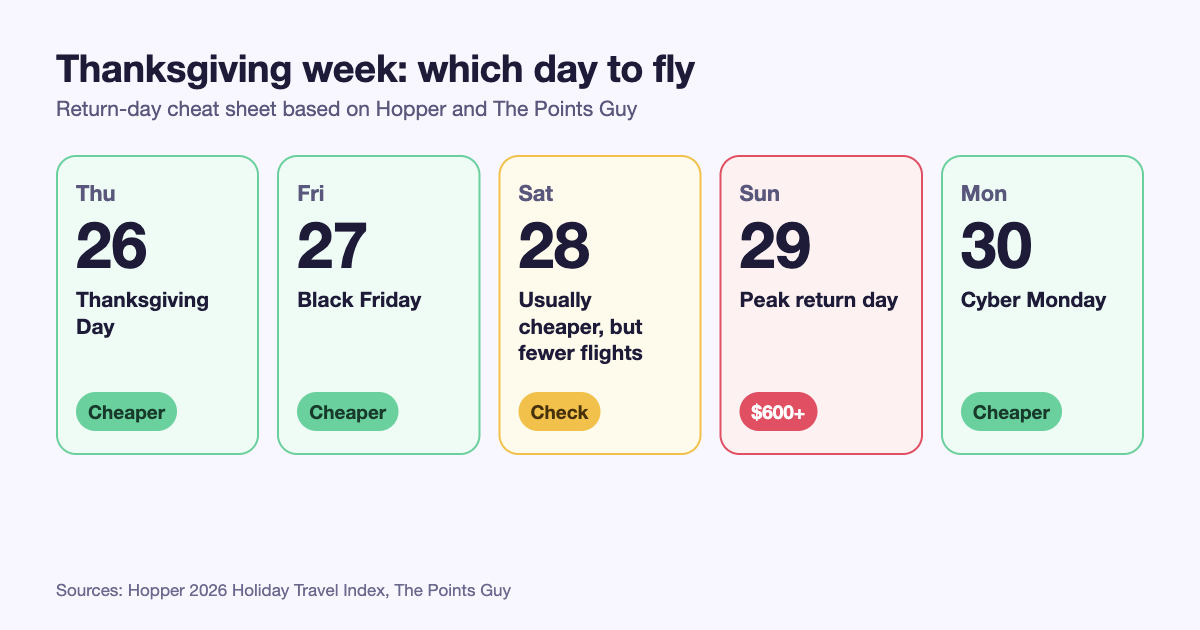
Now the catch. Airlines cut midweek and Saturday flights, so those cheaper days have fewer seats. In fact, the day that is cheap on paper may be sold out. My advice is to look at the full week on a fare calendar, not one date.
Book now or wait? How I would handle holiday airfare
Hopper tells people to book before Halloween, which is next Saturday. I am wary of any deadline pushed by a company that sells booking tools. Even so, the logic holds up for me. Executives say prices will stay. Early booking is already pushing fares higher, according to CNN. And the October dip this year was small.
Here is the plan I would follow:
- Fix your dates first. Moving one day, especially your return, can matter more than any other trick.
- Skip the Sunday after Thanksgiving if you can. That alone avoids the $600 fares.
- Add up the full price. Include bags and seats before you compare airlines.
- Check your perks. If a credit card or status gives you free bags, that airline may win even at a higher fare.
- Book once the price works for you. In the US, you can usually cancel within 24 hours for a full refund if the flight is at least seven days away.
I know waiting feels smart. This year, though, the airlines have said in plain words that they don’t plan to cut. If you’re also booking a place to stay, my post on Airbnb’s new checkout rules covers a rule change worth knowing about.
The short version
Holiday airfare is up 22% to 39% this year, and United and Delta executives expect it to stay high, so waiting for a drop is a risky bet. Book soon, fly on off-peak days like Thanksgiving Day, Black Friday or Cyber Monday, skip the Sunday return, and add bag and seat fees before you compare airlines.