Medicare Advantage Plan Ending in 2027? Do This by Dec 7
On October 23, “medicare advantage discontinuation unitedhealthcare humana” was sitting on the US Google Trends list. Open enrollment started on October 15, so I figure a lot of people are typing the same worry into Google: my plan is ending, now what?
I spent the afternoon reading coverage from Quartz, the New York Post and ConsumerAffairs, then checked the rules on Medicare.gov and in a KFF report on Medigap. This post puts the useful parts in one place.
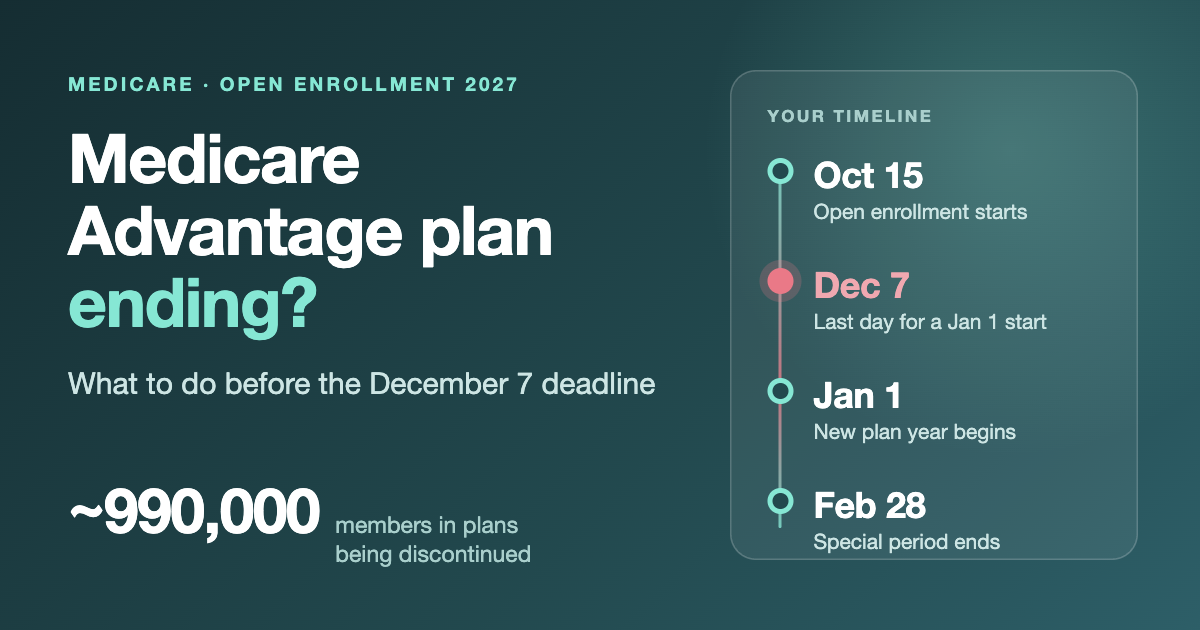
The short answer: if you got a non-renewal letter, pick new coverage by December 7 so it starts on January 1. If you do nothing, UnitedHealthcare says affected members go back to Original Medicare. Original Medicare has no drug plan built in, so you would have to add one yourself.
What is happening with Medicare Advantage plans in 2027
UnitedHealthcare confirmed that about 390,000 members are in plans it is discontinuing. Humana said about 600,000 people are in plans ending in 2027, which is roughly 8% of its 7.2 million Medicare members. Add those up and you get about 990,000 people, which is where the “nearly 1 million” headlines come from.
That sounds huge, and for the people affected it is. The scale still matters, though. Reuters, as cited by Quartz, reported that the government expects about 34 million people in Medicare Advantage in 2027, around 6% fewer than today. By my rough math, the plans these two insurers are ending cover under 3% of current enrollment.
The national numbers look calm
CMS data in the ConsumerAffairs report show the total number of plans moving from 5,553 to about 5,532. More than 99% of beneficiaries will still have at least one plan, and 97% will have at least ten. So this is a local problem more than a national one. Your county decides how much choice you have left.
Who is cutting what
ConsumerAffairs analyzed CMS data county by county. This table has the parts I found most useful.
| Insurer | What was reported |
|---|---|
| UnitedHealthcare | About 390,000 members in discontinued plans, mostly PPOs, and individual plans dropped in about 140 counties |
| Humana | About 600,000 members in ending plans, coverage falling from 85% to just over 80% of US counties, and a hope to keep about 40% of affected members in other Humana plans |
| Aetna | About 123 fewer counties, with more HMO plans |
| Centene | About 344 fewer counties, nearly 20% of its footprint |
| Elevance (many Blue Cross Blue Shield plans) | About 56 fewer counties |
| 11 smaller insurers | Leaving individual Medicare Advantage entirely, including Wellmark Blue Cross Blue Shield and Providence Health Plan |
Why insurers are doing it
Seniors are using more care, and costs rose faster than insurers planned for. CMS did finalize a 2.48% average payment increase for 2027, up from the near-flat 0.09% it proposed in January. Insurers say that still does not keep up. So they keep the plans that make money and drop the rest, often PPOs that let you see out-of-network doctors.
Reuters reported that UnitedHealthcare and Aetna are moving toward plans with more limited provider networks. That matters if you are shopping for a replacement, and I come back to it below.
Is your plan ending? Check the letter first
Two very different letters can land in your mailbox this time of year, and they are easy to mix up.
| What the letter says | What it means | What you can do |
|---|---|---|
| Non-renewal, or “your plan will not be offered in 2027” | Your plan ends on December 31 | Choose new coverage. You get some extra time after December 7, covered in the dates below |
| Annual Notice of Change | Your plan continues, but costs, benefits or networks change | Read the changes, and switch during open enrollment if you do not like them |
| Nothing yet | Not clear | Check your mail and your insurer account, then call the number on your member card |
UnitedHealthcare dated its non-renewal notices October 2. I could not find a notice date for Humana in the coverage I read, so I would not assume that a missing letter means you are safe.
The dates that matter
This is the timeline I would stick on the fridge.
| Date | What happens | Source |
|---|---|---|
| October 2 | UnitedHealthcare non-renewal notices are dated | Quartz |
| October 15 to December 7 | Open enrollment. You can join, switch or drop a plan, and the new plan must get your request by December 7 to start January 1 | Medicare.gov |
| Through December 31 | UnitedHealthcare says affected members can pick another Medicare Advantage plan until then for January 1 coverage | Quartz |
| January 1 | New plan year. If you did nothing, UnitedHealthcare says you revert to Original Medicare | Quartz |
| January 1 to March 31 | Medicare Advantage Open Enrollment. If you are in a Medicare Advantage plan, you can switch to another one or return to Original Medicare | Medicare.gov |
| Through February 28, 2027 | UnitedHealthcare says members who reverted to Original Medicare have a special period to choose a Medicare Advantage plan | Quartz |
Why two deadlines, December 7 and December 31? Medicare.gov lists a plan not renewing its contract as a special enrollment situation, and UnitedHealthcare’s own dates run past December 7. I would still treat December 7 as the deadline. It is the date Medicare.gov prints for everyone, and waiting means leaning on a special rule.
Four ways to handle a plan that is ending
| If you choose | You get | Watch out for |
|---|---|---|
| Another plan from the same insurer | The easiest switch, often a similar plan | A different network, benefits or cost |
| A plan from a different insurer | A fresh comparison for your county | A narrower doctor network |
| Original Medicare plus a Part D drug plan, and maybe Medigap | Any doctor who accepts Medicare | You buy drug coverage yourself, and Medigap can be refused outside protected windows in most states |
| Do nothing | Nothing to fill out | Likely Original Medicare with no drug plan |
1. Stay with the same insurer
This is the path Humana is hoping for. ConsumerAffairs reports it wants to keep about 40% of the affected members in other Humana plans. Same company does not mean same coverage, though. An industry consultant told Healthcare Brew, in the New York Post story, that people may stay with their insurer and still get less than last year, and in many cases they will. Check the doctor list, the drug list, the dental allowance and the out-of-pocket maximum before you accept.
2. Switch to a different insurer
Use the Plan Finder on Medicare.gov. Enter every drug you take and your pharmacy so the yearly estimate is real. Then call your doctors’ offices and ask whether they take that exact plan in 2027. The Medicare.gov enrollment page gives the same advice. A plan with a narrower network can look great on price and still leave your doctor out.
3. Go to Original Medicare and add the extras
With Original Medicare you can see any doctor who accepts it, and you buy the extras separately. That means a Part D drug plan and, if you want predictable costs, a Medigap policy. For 2027, Medicare.gov says no drug plan can have a deductible above $700, and your yearly out-of-pocket spending on covered drugs stops at $2,400 ($2,100 in 2026).
Three traps worth knowing about
The drug coverage gap
Medicare.gov says you pay an extra 1% for each month you go 63 days or more without creditable drug coverage, and the penalty stays for as long as you have drug coverage. It is based on the national base premium, which was $38.99 in 2026. Using that number, a six-month gap would add about $2.30 a month. That is my own math, not an official quote.
So the penalty itself is small. The bigger cost is paying full price at the pharmacy until you sign up.
Medigap is not guaranteed
KFF explains that federal law gives Medicare Advantage members guaranteed issue rights to buy a Medigap policy if their plan ends or leaves their area, and people generally have 63 days to apply. Outside those windows, insurers in most states can use medical underwriting. That means they can turn you down or charge more because of your health.
Four states (Connecticut, Massachusetts, Maine and New York) require continuous or annual guaranteed issue for everyone 65 and older, and other states add their own rules. Ask a licensed agent or your state counselor exactly when your 63 days start and end.
Quiet downgrades
Plans that are not ending can still get worse. ConsumerAffairs says some insurers are cutting extras like dental allowances and Part B premium giveback. The New York Post reported that among UnitedHealthcare, Humana, Centene and Clover, only Humana did not reduce dental benefits, and Clover raised its maximum out-of-pocket by $1,144, the biggest jump of the group.
My read: the million-person headline is the loud part. Smaller changes to networks and benefits probably touch far more people, and nothing in the mail says “plan ending” when they do. That is why I would compare plans even if yours survives.
A 20-minute checklist
- Find your letter, or log in to your insurer account, and write down your plan name and the notice date.
- List every prescription with its dose, plus the pharmacy you use.
- List your doctors and the hospital you would go to.
- Run all of it through the Plan Finder and compare the yearly cost, not only the monthly premium.
- Call each doctor’s office and ask: “Do you accept this plan in 2027?”
- Enroll before December 7 and save the confirmation number.
- Want a second opinion? Your State Health Insurance Assistance Program (SHIP) offers free counseling that is not tied to any insurer, and 1-800-MEDICARE (1-800-633-4227) is open too.
Quick answers
What happens on January 1 if I do nothing?
UnitedHealthcare says affected members revert to Original Medicare. Your hospital and doctor coverage continues, but drug coverage and any extras from your old plan end, so you would need to add a drug plan yourself.
Can I change my mind after January 1?
If you are in a Medicare Advantage plan, yes. Medicare.gov lets you switch plans or return to Original Medicare between January 1 and March 31. If you already reverted to Original Medicare, UnitedHealthcare says a special period runs through February 28, 2027.
Do I have to stay with UnitedHealthcare or Humana?
No. You can join any plan offered in your county, as long as you have Part A and Part B.
Will my doctor still be covered?
Only if the doctor is in the new plan’s network, so call the office before you enroll. Networks are changing even in plans that are not ending.
I am not a licensed insurance agent, and this is general information. For your own plan, call the number on your member card or a SHIP counselor.
The short version
UnitedHealthcare and Humana are ending Medicare Advantage plans for about 990,000 people in 2027, so check your mail for a non-renewal letter and choose new coverage, drug coverage included, by December 7. If you do nothing, you will likely land in Original Medicare with no drug plan.