Flying Fox Starvation: What to Do If You Find a Bat
Flying fox starvation was the one story in this week’s trending feeds that I could turn into something useful. Thousands of grey-headed flying foxes are starving along Australia’s east coast, and more of them are turning up in backyards in broad daylight. I read the news reports and the health advice, because the question most people have is simple: what do you do if one lands in your yard?
Here is the short answer. Do not touch it, and call a wildlife rescue group. I wrote this on Saturday, Oct. 24, and every number below comes from the reports I link to.
What flying fox starvation looks like right now
Wildlife carers say they have never seen numbers like this. Ben Dessen, who runs the Hills Wildlife Sanctuary in Sydney, told 7NEWS that thousands of flying foxes came into care over three to four weeks. The animals arrive “emaciated, really, really thin and starving,” Dessen said.
Also, it is not just Sydney. Port Macquarie News reported that volunteer carers on the Mid North Coast recorded 180 deaths in two weeks. Meanwhile, the NSW environment department told NSW Health that the food shortage runs along the east coast, from the Clarence Valley in the north to the South Coast.
The department expects things to return to normal once natural food becomes more widely available. However, that depends on the weather, so nobody can say when.
Why flying fox starvation hit this spring
Grey-headed flying foxes eat nectar, pollen, blossoms and fruit, and 7NEWS says each bat needs about 500 g a night. Spring is when native gums normally flower. It is also when the mothers have pups, so the timing could hardly be worse.
This year the flowers came late, and the trees that did bloom gave very little nectar, according to Dessen. Brett Summerell, chief scientist at the Sydney Botanic Gardens, linked it to an unusually dry winter and spring. The Bureau of Meteorology figures in that report show parts of the NSW east coast, Sydney included, got 50 mm to 100 mm of rain over winter, roughly 100 mm to 200 mm below average.
Still, not everyone points at the same cause. Yahoo News reports that one hypothesis blames unseasonal heavy rain that washed pollen and nectar out of the trees, and a Victorian rescuer told them it is “not entirely clear why it’s happening.” So the honest answer is that experts are still working it out.
Why bats are out in daylight
This is the part that makes people nervous. WIRES, the big NSW wildlife rescue group, said bats have been “eating off the ground, drinking water from the grass after the rain, and hanging too low in trees,” according to the Sydney Morning Herald.
Normally, flying foxes spend the day in big colonies and fly out at night. But in a food shortage they stay in the feed trees instead. That is why you might find one in your backyard fruit tree at noon. By itself, a daytime bat is not always a bat in trouble, which matters for the next section.
There is a human side too. At one Victorian office, a staffer named Sam Brand, who volunteers as a rescuer, has been bringing in orphaned pups for feeds, up to eight at a time, Yahoo News reports. Brand called finding so many orphans this early in the season “unusual.”
What to do about flying fox starvation if you find a bat
The advice from NSW Health and WIRES lines up, and the reason is a virus. Australian bat lyssavirus is a close relative of rabies. NSW Health’s fact sheet says any bat in Australia could carry it, and a bat’s looks or behaviour do not tell you if it does. Only vaccinated, trained handlers should touch one. The same fact sheet says to avoid handling bats overseas too, so this applies wherever you live.
If the bat is on the ground, caught or a pup
- Stay back. Keep children and pets away too.
- Call for help. NSW Health gives WIRES on 1300 094 737, or you can call your local wildlife rescue group. NSW Health also points to the IFAW Wildlife Rescue app.
- Add shade on a hot day. WIRES says to do it only if you can do it safely.
- Do not pull a bat out of netting or wire. WIRES says to call its rescue line straight away instead.
If the bat is in a tree and looks fine
This one confused me at first. The WIRES emergency page says that in the northern NSW emergency area (Mid North Coast, Clarence Valley, Northern Rivers), a lone bat that looks uninjured should simply rest. If it is still there the next day, call. Elsewhere in NSW, call WIRES for advice. That page does not show a date, so treat it as a guide, and when you are unsure, a quick phone call costs nothing.
| What you see | What to do |
|---|---|
| Bat on the ground, injured or a pup | Do not touch it. Call WIRES on 1300 094 737 or your local rescue group. |
| Bat caught in netting or wire | Call the rescue line straight away. Do not pull it free. |
| Lone bat in a tree, looks uninjured | Watch from a distance. Call if it is still there the next day, or sooner if you are outside northern NSW. |
| Dead bat | Do not touch or move it. Call your local rescue group or council for advice. |
One conflict to flag. The WIRES page says a dead bat can be scooped up in a towel or newspaper. However, NSW Health says not to touch or move dead wildlife. I would follow the stricter advice.
If a bat bites or scratches you
This is where the numbers got my attention. NSW Health assessed 43 people after bat bites or scratches between Sept. 28 and Oct. 10, compared with 10 in the same two weeks of 2025. That is about four times as many (my math: 43 divided by 10).
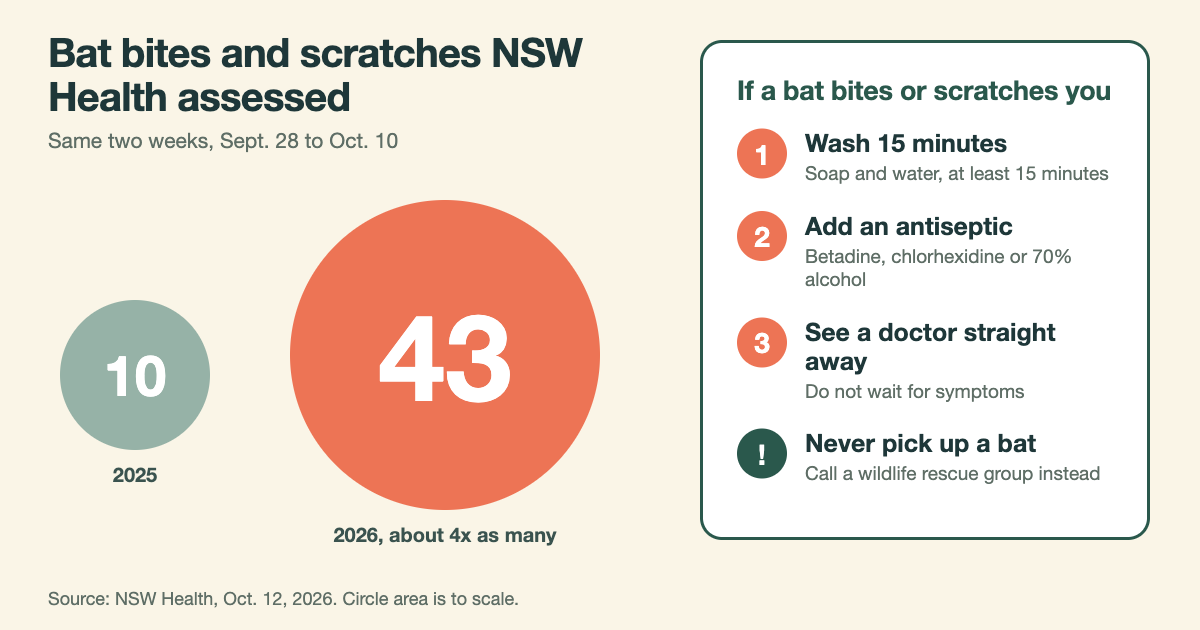
If it happens to you, NSW Health lists three steps:
- Wash the wound with soap and water for at least 15 minutes.
- Apply an antiseptic that kills viruses, such as povidone-iodine (Betadine), chlorhexidine, or alcohol with at least 70% ethanol.
- See a doctor straight away. Do not wait for symptoms.
Why the rush? According to the fact sheet, there is no effective treatment once symptoms start, and symptoms can take anywhere from days to years to show up. Treatment after exposure is rabies immunoglobulin plus a vaccine course. If you have never been vaccinated, that means four or five injections over a month.
Still, the risk is small. The same fact sheet counts only four human cases since the virus was identified in 1996: three in Queensland and one in NSW, in July 2025. It also says contact with droppings, urine or blood, or walking near a roost, does not carry a risk if you do not handle the bats. So I would not avoid the park. I would just never pick one up. If a bat turns up in a child’s room, or you are unsure whether you got scratched, call a health professional or your local public health unit (1300 066 055 in NSW). For another animal-linked virus story, see my Shamonda virus post.
How to help during flying fox starvation without touching a bat
Carers have asked for a few things. First, fruit. Dessen suggests hanging chunks of apple, or big watermelon wedges, in a tree. The WIRES page suggests apple or pear placed high in nearby trees, without going near the bat. The sanctuary alone goes through more than 200 kg of fruit a week.
Here is some rough math to keep this in proportion. The Sydney Morning Herald reports that Greater Sydney Parklands has spotted more than 40,000 bats at Lachlan Swamp in Centennial Parklands. If each ate its full 500 g, that colony would need about 20 tonnes a night. So a watermelon wedge helps one tired bat, not a colony, and I would call that worth doing but not a fix.
- Hang fruit high in a tree, well away from the bat.
- Plant native trees. Dessen says they feed bats, birds and insects once they flower.
- Support your local rescue group. Dessen says volunteers and small charities do the work and pay for it out of their own pockets.
- Keep pets inside if a bat is on the ground nearby.
What nobody knows yet about flying fox starvation
Several questions are still open. First, the cause. Dry winter and heavy rain are both on the table, depending on who you ask. Second, summer. The Sydney Morning Herald says the heat could make things worse, and Greater Sydney Parklands plans to close colony sites when temperatures go above 42 degrees. Third, support. Dessen said the state and federal governments had not stepped in with help yet.
This is not only a cute-animal story, either. Flying foxes are Australia’s only long-range pollinators, Yahoo News reports, and the species counts as vulnerable to extinction. Research cited by the Sydney Morning Herald estimates they plant about 91 million trees a year.
What stayed with me is how small the public’s job is. You do not need to be brave or trained. You only need to keep your hands off and make one call. If I lived on the east coast, I would save the rescue number in my phone today.
The short version
Thousands of grey-headed flying foxes are starving on Australia’s east coast, so more bats are turning up in backyards. Do not touch one; call WIRES on 1300 094 737 or your local rescue group, and if a bat bites or scratches you, wash the wound for 15 minutes and see a doctor straight away.