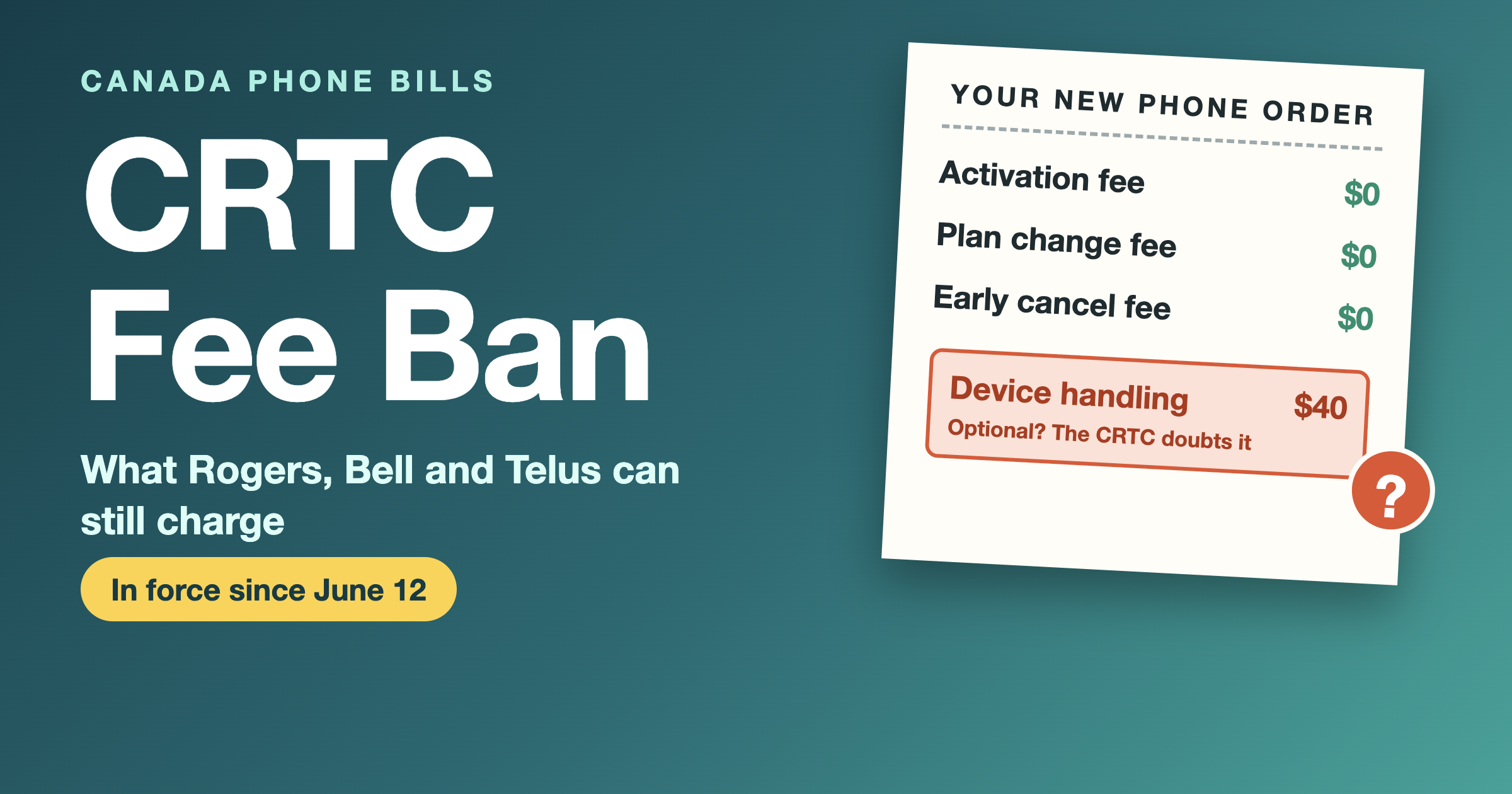
CRTC Fee Ban: What Rogers, Bell and Telus Can Still Charge
Canada’s CRTC fee ban has been in force since June 12, and this week it showed up in Rogers’ earnings report. On Oct. 23, Rogers blamed part of a dip in wireless revenue on the rule. At the same time, Rogers, Bell and Telus are charging new device and SIM fees that the regulator says look a lot like the old ones. I read the CRTC decision, the show-cause notice and the complaint pages of the telecom ombudsman to sort out what you can actually be charged today.
I wrote this on Oct. 24. The CRTC has not ruled on the new fees in anything I could find, so some of this may change.
What the CRTC fee ban covers
First, the basics. The CRTC announced the rule on March 12 in Telecom Regulatory Policy 2026-43 and began enforcing it on June 12. It does two things.
- It bans any fee for activating a new phone or internet plan, or for changing an existing one.
- It bans early cancellation fees when you did not get a subsidized device with your contract.
Next, who gets protected. The CRTC says the rules cover individual and small business customers of mobile services, plus individual customers of home internet from providers that fall under the Internet Code. As a result, the old activation charge on a new line should be gone for most people. Daily Hive put it simply on June 12: Canadians no longer pay fees to cancel or modify their phone or internet plans.
What the CRTC fee ban leaves alone
However, the ban has gaps, and the regulator wrote them in on purpose. The decision says two kinds of charges stay legal.
- Reasonable fees for physically installing a service at your home or business.
- Fees for extra products or services you explicitly chose to buy. The CRTC’s example is Wi-Fi setup at your home.
Also, early cancellation fees on subsidized phones survive. Under the Wireless Code, that fee cannot exceed the value of the subsidy, and it has to shrink in equal steps to $0 within 24 months at most. Still, the CRTC says it will look at device rental plans later, when it merges the Wireless Code and the Internet Code into one.
The fees at the center of the CRTC fee ban fight
Soon after the rule took effect, three new charges appeared. The CRTC’s notice lists them with the dates its staff first heard about each one. Here is the summary, with each company’s defence.
| Carrier | Fee | Company’s defence |
|---|---|---|
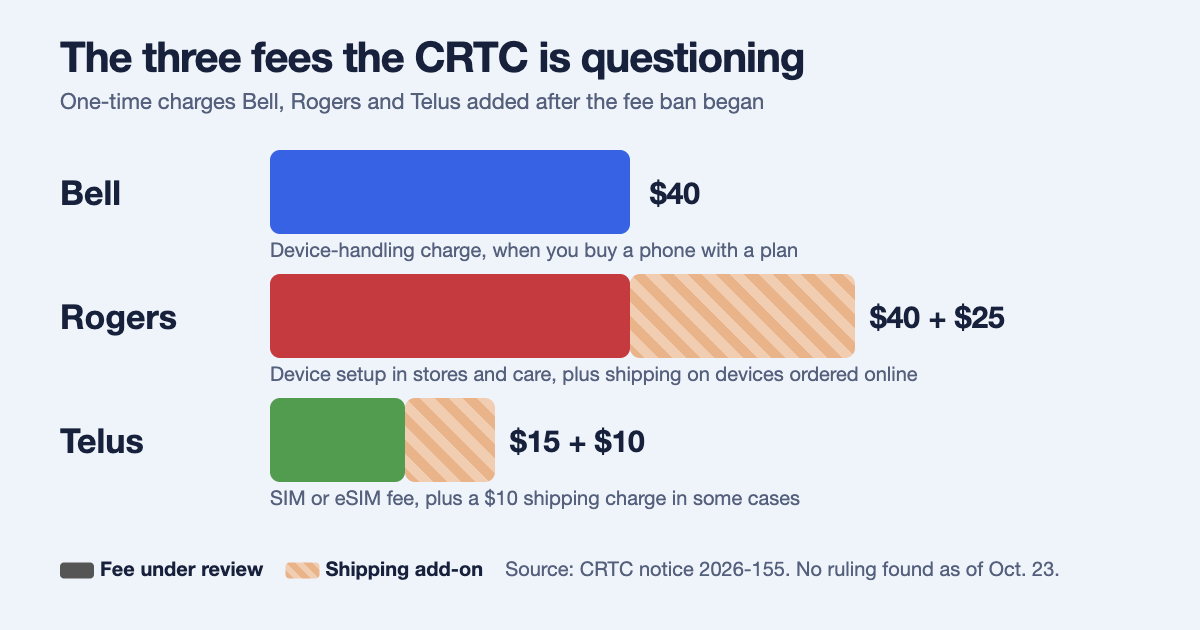
| Bell | $40 device-handling charge when you buy a phone with a plan (staff learned May 6) | Buying a phone is optional and a separate deal from the plan, and the fee covers real costs |
| Telus | $15 SIM or eSIM fee (staff learned June 9), plus a $10 shipping charge in some cases | People buy SIMs for travel or replacements, so it is a product, not an administrative fee |
| Rogers | $40 device setup charge, $25 shipping on devices ordered online, and a SIM fee (staff learned June 16) | Setup applies only in stores and customer care, and the shipping and SIM fees are older charges |
The regulator does not buy it. The Canadian Press quoted Scott Hutton, the CRTC’s vice-president of consumer, analytics and strategy: “You need a phone for your plan. It’s no more complicated than that.” Likewise, Hutton said a SIM card is not optional either.
Meanwhile, the OpenMedia advocacy group agrees. Executive director Matt Hatfield told CBC News that a SIM is required to connect to a network, so he doubts it can count as optional. On the other side, I think Telus has a fair point about travel SIMs and lost cards when someone buys one on its own. The harder question is what happens when the SIM is a required part of a new plan.
Where the CRTC fee ban case stands today
The CRTC opened a formal show-cause case on June 30. Here is how it has gone so far, based on the notice, iPhone in Canada and the CP story:
- June 12: the fee ban takes effect.
- June 30: the CRTC orders Bell, Telus and Rogers to explain why the new fees do not break the rules.
- July: the companies tried to stall the case. Mid-August: the CRTC said no, according to iPhone in Canada.
- Aug. 31: public comments close. Quebecor tells the regulator that Videotron, Freedom and Fizz dropped those fees or never charged them.
- Sept. 10: the three companies file their last replies.
After that, I found nothing. The CRTC’s releases page for Oct. 23 lists two cost awards, and the decisions it expects next week do not mention this case. So for now, none of the disputed fees is struck down and the companies can keep charging them.
If the CRTC finds a violation, each company faces a penalty of up to $10 million, and relevant officers or directors up to $25,000. The regulator can also order the companies to comply, within 60 days according to the CP story. Still, Hatfield warned that the telecoms may earn more during the dispute than any fine would cost, so the money is not a sure deterrent.
What Rogers’ earnings say about your bill
This is where the topic hit the news. According to the Financial Post, Rogers said wireless service revenue fell 1% to $2.03 billion in the third quarter, and it pointed mainly at the lost activation and modification fees. Average revenue per mobile phone user fell 2.6% to $55.22, which Rogers tied to the ban plus tough competition.
Here is my math. If $55.22 is 2.6% lower than the earlier figure, that earlier figure was about $56.69. The gap is roughly $1.47 a month per phone, and it mixes the fee ban with price competition, so the ban alone is smaller.
Chief financial officer Glenn Brandt told investors the fees “were initially designed to recover specific costs within our business, and so we’re now moving back to finding alternatives for covering those costs.” Honestly, that line made me sit up. My guess is that companies will try to earn that money back in plan prices, promotions or new line items, so the fine print matters more than before.
How to protect yourself under the CRTC fee ban
Check the order before you sign
First, read the one-time charges on your order summary. The Wireless Code already requires providers to disclose their fees, so ask for the full list before you agree. Then ask a simple question: is this fee optional? If the answer is no, ask the rep to remove it.
Also, think about where you buy. Rogers says its $40 setup charge does not apply to self-serve purchases, but its $25 shipping charge applies to devices ordered online, so by my reading you may face one or the other. Meanwhile, Quebecor says its brands dropped these fees, which is worth a look if you are shopping around.
Cancelling a plan
If your contract came without a subsidized phone, you should not pay an early cancellation fee at all. If you did get a subsidy, check the fee in your contract. It can never be higher than the subsidy, and it has to reach $0 by month 24 at most.
Filing a complaint with the CCTS
Finally, if a fee looks wrong, start with your provider and write down each contact. If that fails, ask for a supervisor. Then file with the Commission for Complaints for Telecom-television Services. Per the CCTS process page, the online form takes about 15 minutes, and your provider has 20 days to report back. Most complaints end at that stage.
The CCTS can tell a provider to fix a billing error or reimburse proven losses up to $5,000. However, it does not fine anyone, since that job belongs to the regulator. You can also file by phone at 1-888-221-1687. Besides, the CRTC asked the CCTS to report on complaints about activation and modification fees, so your complaint also becomes data.
If you are watching your budget this month, my post on the Bank of Canada rate decision covers the other big Canadian bill story.
My take on the CRTC fee ban
The rule is clear on paper, and the aim makes sense: nobody should pay a toll to switch. Still, this case shows the usual problem with banning fees by name. Rename the fee, call it a device charge, and the fight starts again.
I would not assume the fees are illegal until the CRTC says so. Both sides have arguments, and the notice is a call to explain, not a verdict. But I would not pay quietly either. A one-minute question at the counter costs nothing, and a refund order, if one ever comes, would be easier to claim with your receipt in hand. As of today, I found no refund order.
The short version
Since June 12, Canadian phone and internet companies cannot charge activation or plan-change fees, but Bell, Rogers and Telus still bill $40, $40 and $15 device and SIM charges that the CRTC says look like the banned kind, and no ruling had appeared by Oct. 23. Read your order summary, ask for any required fee to be dropped, and file with the CCTS if the provider refuses.