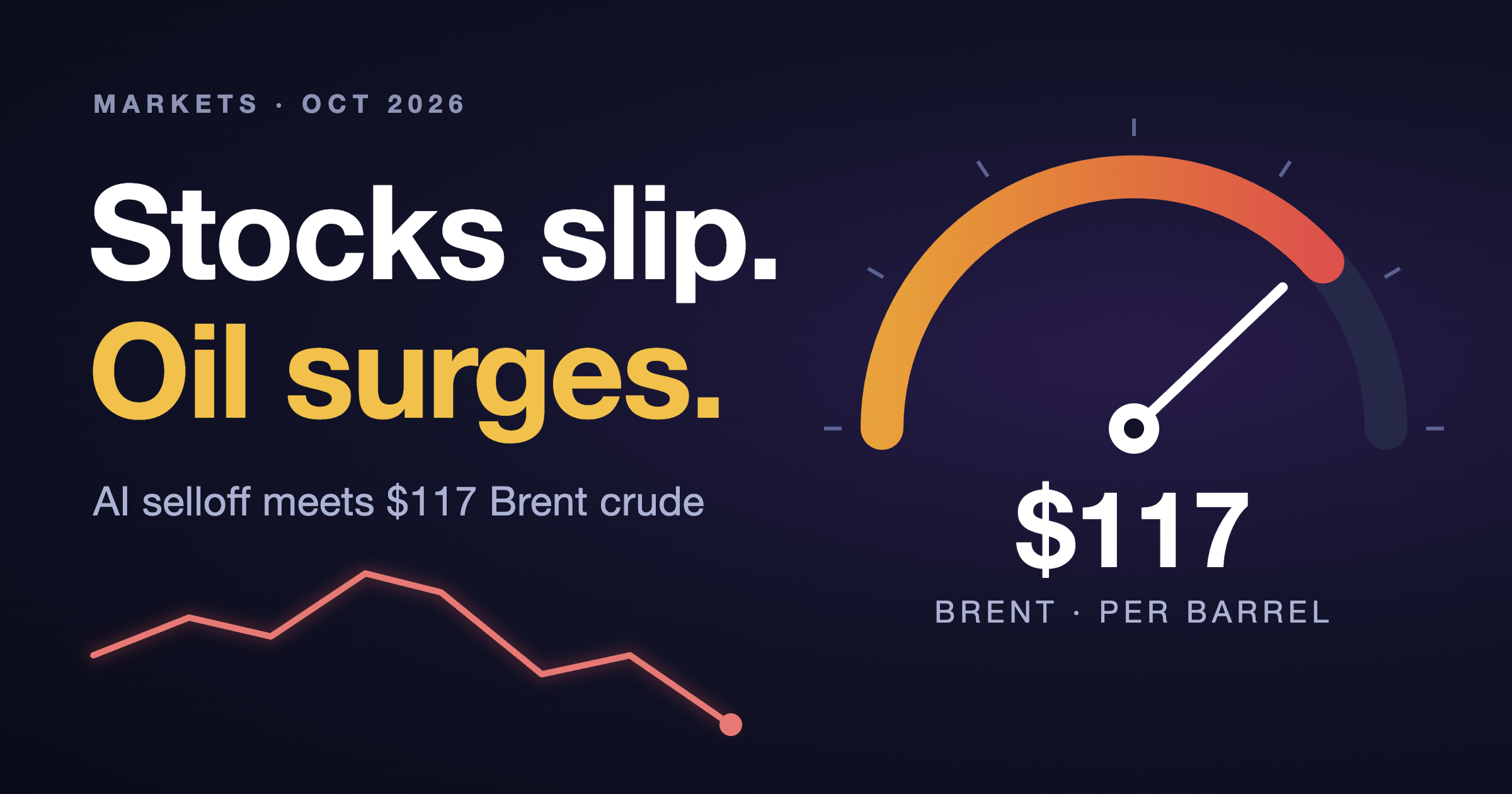
Stock Market Drop: AI Selloff and $117 Oil, Explained
The stock market drop on Thursday came from two separate problems that landed on the same day. AI stocks sold off hard, and oil jumped to a five-month high. I spent this morning reading the AP’s market report, The Guardian’s oil coverage and AAA’s gas price page to figure out which one matters more for regular people.
Here is where I ended up. The AI selloff grabbed the headlines, but most stocks actually rose that day. The oil move is the one that will reach your wallet through gas, diesel and airfares. So I’ll cover both, then list what I would check this weekend.
What happened in the stock market drop on Thursday
Thursday, October 22, was the S&P 500’s worst day since July. The Nasdaq took a bigger hit, and the Dow barely moved. That gap explains a lot, and the numbers below come from the AP report and The Guardian’s oil story.
| Measure | Thursday, Oct 22 | Why it matters |
|---|---|---|
| S&P 500 | Down 1.2% to 7,663.43 | Worst day since July |
| Nasdaq composite | Down 2.6% to 26,008.86 | Tech-heavy, so it took the hit |
| Dow Jones | Up 11.89 points to 52,867.98 | Barely moved |
| Nvidia | Down 4.4% | Biggest single drag on the S&P 500 |
| 10-year Treasury yield | 4.97%, from 5.13% a day earlier | Investors bought bonds for safety |
| Brent crude | Up 4% to $113.17 | Touched a five-month high |
Friday was rough too. AP reported that the S&P 500 slipped another 0.4% and the Dow fell about 1.1% during the session, while Brent touched $117 for the first time since April. Those were midday figures in the AFR’s copy of the report, so check the closing numbers before you quote them anywhere.
Why AI stocks led the stock market drop
The strange part is that the earnings reports were not bad. Lam Research, which supplies chip-making equipment, beat analysts on profit and revenue. Its stock still fell 11.8%. Meta beat on revenue but missed on profit, and it said it would create a new class of stock to raise money for AI spending. Its shares dropped 7%. Tesla beat on profit, missed on revenue and slid 3.1%.
Borrowing costs are the real worry
AP’s explanation is that AI companies now spend so much on datacenters and chips that borrowing costs matter a lot. CoreWeave, which borrowed money to buy Nvidia chips and rents them out, fell 10.1% on debt worries. Nvidia is the largest company on Wall Street by value, so its 4.4% slide pulled the index down more than any other stock.
The Meta detail stuck with me. Investing.com’s earnings recap put its revenue at $64.6 billion, up 26% from a year earlier, and the company still wanted a new share class to fund its plans. When a business that profitable starts doing that, I think it is fair to ask how long the spending can run before it pays back. That is my read, not a prediction.
The quieter story: most stocks went up
Two out of every three stocks in the S&P 500 rose on Thursday. They just got drowned out. Procter & Gamble gained 5.6% after beating profit expectations, and Lockheed Martin and CSX also topped forecasts.
This is why I do not like reading a single index number. If you own an S&P 500 fund, a handful of AI giants drive a big chunk of your daily result. The average company in the index had a decent day, and your account balance can still look ugly.
Why oil hit $117
Brent crude, the global benchmark, sat below $97 at the start of October. It closed Thursday at $113.17 and touched $117 on Friday, its highest since April. For context, here is how the year has gone, using the figures from the same two reports.
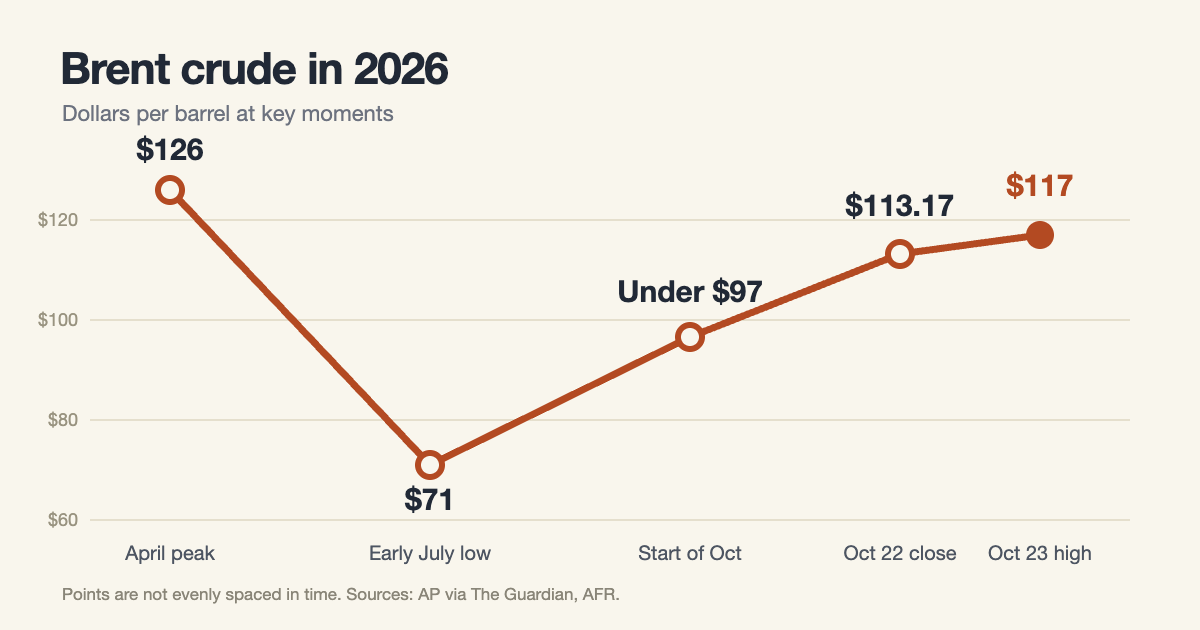
Oil peaked at $126 in April, fell to a low of $71 in early July on ceasefire hopes, then started climbing again after the US-Iran memorandum of understanding fell apart. The jump this week came on top of that.
What pushed it up this week
- Attacks in Saudi Arabia. Yemen’s Houthis hit several targets on Wednesday, including a drone strike on a Saudi oilfield and an airport in Dammam.
- Ships in the Gulf. Iran’s Revolutionary Guard said it hit four vessels in the northern Gulf, and three more struck mines west of the Strait of Hormuz.
- Evacuation moves. Reuters reported that the US ordered some diplomats’ families out of Saudi Arabia, and Saudi Aramco told staff at its Dhahran headquarters to work remotely.
One detail made me slow down. Kpler data cited by The Guardian shows that oil exports from the Persian Gulf are above prewar levels, helped by pipelines to the Red Sea and the Gulf of Oman. So supply has not collapsed. The price move looks partly like a bet on escalation, which is my reading and not a fact.
Brent vs. WTI: why the headlines show different numbers
If you checked AAA’s weekly note, you saw crude “nearing $100.” That figure was WTI, the US benchmark, which settled at $97.15 on Wednesday. The $113 and $117 numbers are Brent. They come from different days as well, but the point holds: both are real, and they measure different things.
What the stock market drop means for your wallet
Gas and diesel
AAA’s national average for regular was $4.29 on October 23, against $3.07 a year ago. By my math, that is about $1.22 more per gallon. It is 6 cents lower than a week ago, but AAA says the dip comes from the switch to cheaper winter-blend gasoline, and high crude is stopping bigger drops. AAA also says October is on track to be the most expensive October ever for gas.
Diesel sits at $6.32 a gallon. Its record is $6.5276, set on September 22. With Brent climbing this week, I would not count on the winter-blend discount to keep going. My guess is that the slide stalls, though it is only a guess.
Flights
American Airlines dropped its hope of a profit this year and cited “historic fuel cost pressure.” Its shares fell almost 4% in premarket trading. If you have not booked holiday flights yet, my airfare post covers when to book. I would not wait for fares to get cheaper while fuel keeps climbing.
Rates and borrowing
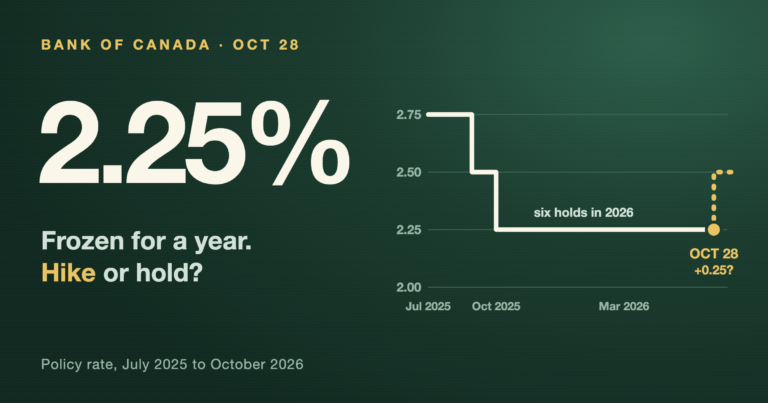
The 10-year yield fell to 4.97% because investors rushed into bonds as AI stocks slid. That is a big one-day move, but yields were above 5.30% earlier this month, and AP says they recently hit their highest levels in decades. Also, the Fed meets next week with inflation worries in the mix. In Canada, the Bank of Canada decides on October 28, and I wrote about that here.
What to check after a stock market drop
I am not a financial adviser, so treat this as the checklist I would use for myself.
- Look at your fund’s top holdings. In an S&P 500 fund, Nvidia is the biggest weight, so AI days hit you harder than the headline suggests.
- Put the day in context. The S&P 500 hit a record high earlier this month. By my math, a 1.2% drop costs about $120 on every $10,000 in an S&P 500 fund, and a Nasdaq-heavy fund lost closer to $260.
- Update your fuel budget. Use $4.29 gas for November, not last year’s $3.07.
- Skip the one-day decisions. One bad session did not change anyone’s long-term plan, and the next two weeks of data will say more.
What I am watching next
- Whether Brent holds above $110 when markets reopen on Monday.
- The Fed meeting next week and what it says about inflation.
- More Gulf headlines, especially around the Strait of Hormuz and Saudi Arabia.
- Whether good AI earnings keep getting sold, which would say a lot about how nervous investors really are.
The short version
The S&P 500 fell 1.2% on Thursday, its worst day since July, as AI stocks sank on borrowing worries while Brent oil climbed to $113 and touched $117 on Friday. Most stocks actually rose, but gas at $4.29, diesel at $6.32 and fuel-hit airlines are where this reaches your wallet.