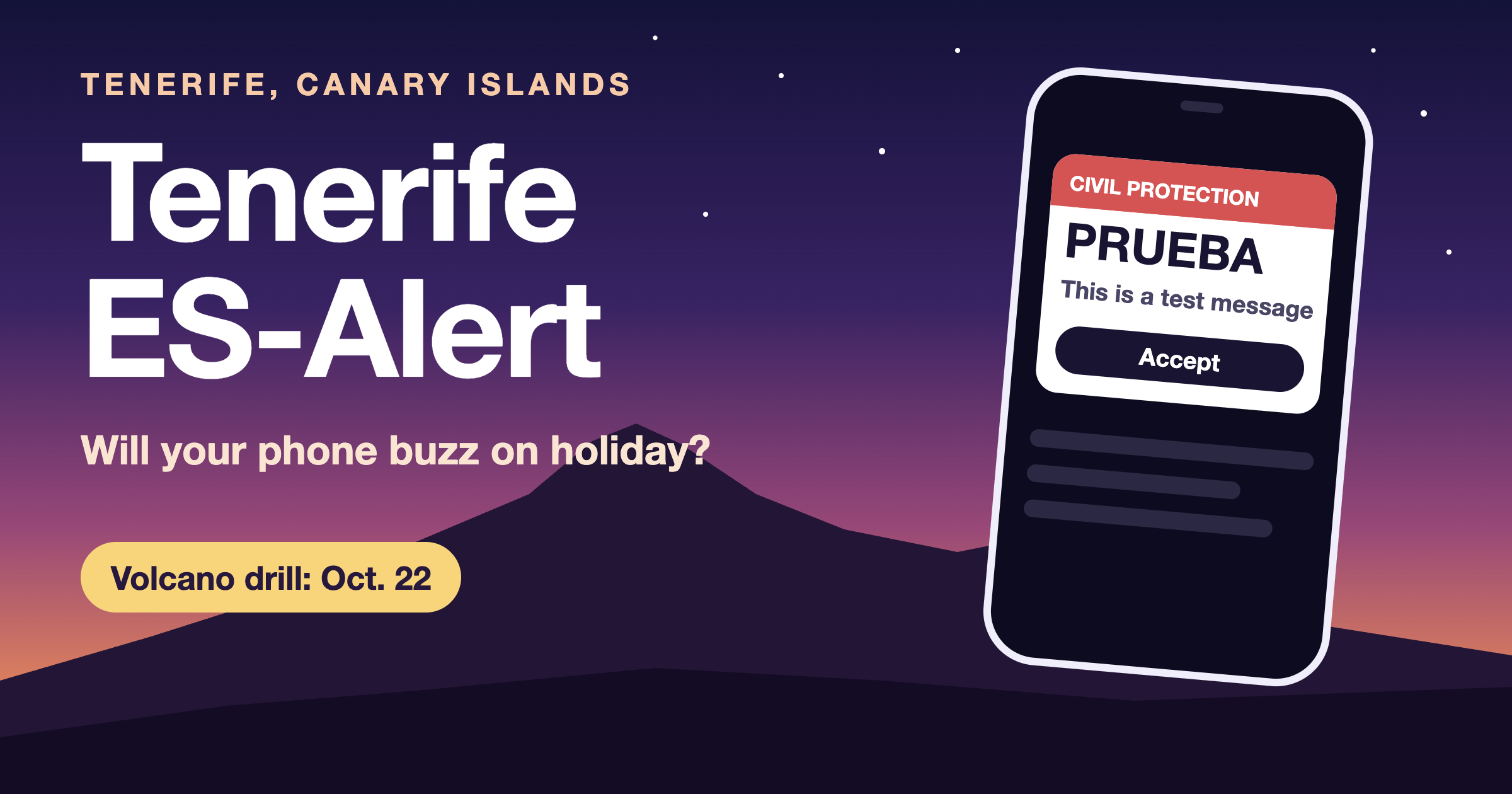
Tenerife ES-Alert: Will Your Phone Buzz on Holiday?
If you are flying to the Canary Islands for half term, the Tenerife ES-Alert story probably popped up in your news feed this week. The headline said an emergency alert was coming to holidaymakers’ phones. It was a test, and it already happened on Thursday, Oct. 22. Still, the questions behind it are real, so I spent the morning reading the Canary Islands emergency service page, Spain’s civil protection FAQ and the local press, and then I checked what scientists said about the volcano.
I wrote this on Oct. 24. Also, the volcano details below come from the latest reports I could open, so treat them as a snapshot and not a live feed.
What the Tenerife ES-Alert test actually was
First, the basics. The Cabildo of Tenerife, the island government, ran a volcano drill called VOLCANEX Tenerife 2026 in the municipality of Guía de Isora. The Canary Islands government used it to test ES-Alert, which is Spain’s system for pushing emergency messages straight to phones. According to RTVC’s live coverage, more than 1,500 people took part, and it was the second drill of this kind on the island.
The test sent three messages between 9 a.m. and 2 p.m. Here is the order, based on the Diario de Avisos guide and the La Voz Canaria report:
- Around 9 a.m.: an island-wide message announcing a simulated move to the orange volcanic alert level. It could also reach parts of Gran Canaria, La Palma, La Gomera and El Hierro, plus the sea channels between the islands.
- Around 11 a.m.: a message for Guía de Isora and Santiago del Teide about a simulated preventive evacuation of the villages of Chirche and Aripe. RTVC said the exercise moved about 300 residents.
- Around 2 p.m.: a closing message to end the exercise.
Every message carried the word PRUEBA, which means test. The government said there was no real volcanic emergency, no eruption and no evacuation order for the island. Also, RTVC reported that the first alert reached much of Tenerife.
The Manchester Evening News pointed out that British families on their way out for half term could be caught off guard, because some schools broke up early. That is a fair point. A loud alert tone in a hotel room is a strange way to meet a new country’s emergency system.
Is the volcano really about to erupt?
No eruption is expected soon, according to the scientists. But the island is not completely quiet either, and I think both halves of that sentence matter. The picture below shows the gap between what the drill pretended and what the latest update says.
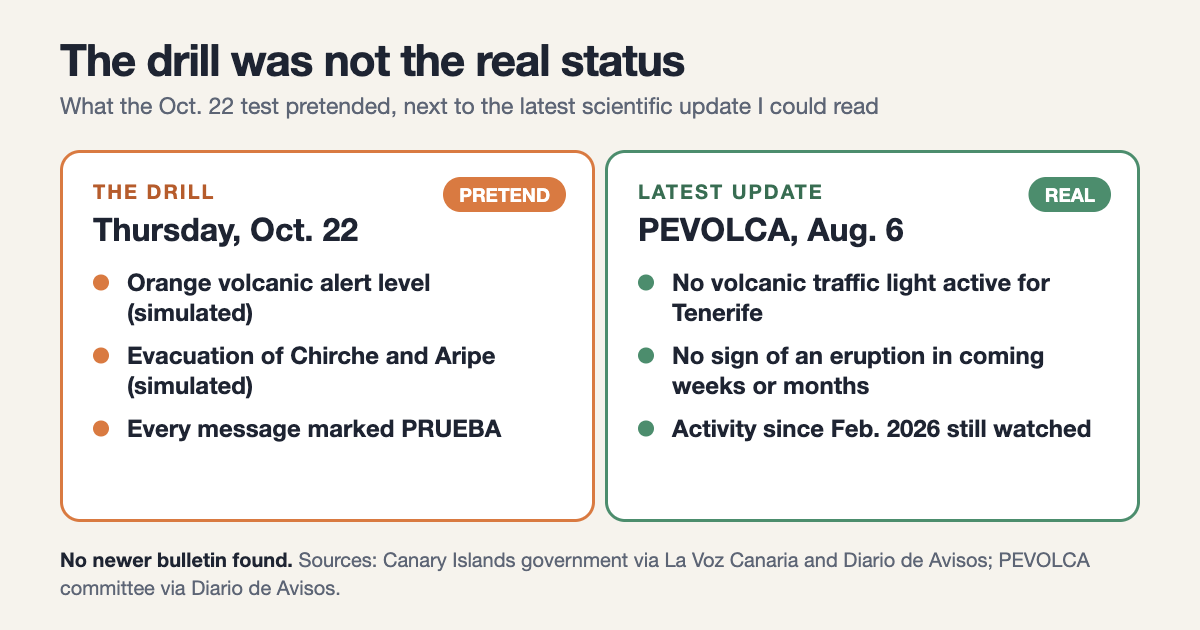
The PEVOLCA scientific committee met on Aug. 6. Its advisers said they see no sign of an eruption in the coming weeks or months, and no conditions to raise Tenerife to orange, as Diario de Avisos reported. However, abnormal seismic and volcanic activity has been running under the island since February 2026. The committee said it could produce light earthquakes that people might feel near Las Cañadas del Teide, and it put ground deformation at around 2 centimeters over the past three years.
Domínguez, the IGN director in the Canary Islands and the committee spokesperson, was blunt about the trend. “We know we are above the activity level of a year ago, and a year ago we were above that of ten years before,” Domínguez said (my translation from the Spanish).
Meanwhile, regional minister Manuel Miranda said in July that there were no scientific grounds to switch on a volcanic traffic light for Tenerife, while La Palma sits at yellow because of gas emissions near Puerto Naos and La Bombilla, per Europa Press via Diario de Avisos. The committee agreed to meet every three months, so by my count the next scheduled check lands around early November. I found no bulletin newer than August, so check the IGN and Involcan pages for the live picture.
So the drill was practice, nothing is about to blow, and the island is being watched closely. That mix is what I would want from an emergency plan.
How a Tenerife ES-Alert reaches your phone
ES-Alert uses cell broadcast, which means phone towers push the message to every compatible phone in an area at once. Per the civil protection FAQ, you do not install an app, register or hand over a number, and the alert system does not receive your location. Instead, your phone only needs a 4G or 5G connection to a network.
Tourists are covered too. The Diario de Avisos guide says the system does not separate residents from visitors, and that you do not need a Spanish number. Likewise, if your phone is not set to Spanish, the message can also arrive in English.
Which phones get a Tenerife ES-Alert
Here is how different situations play out, based on the official FAQ and the Canary Islands guidance:
| Your phone | Does the alert show? |
|---|---|
| On, locked, on silent or in Do Not Disturb | Yes, with sound, vibration and an on-screen message |
| Android 11 or newer, iOS 15.6 or newer | Yes, and it is switched on by default |
| Android 9 or 10 | Yes, but the label may read “Presidential Alert” instead of “Civil Protection Alert” |
| Android 8 or older | No |
| Switched off or in airplane mode | No, but it can appear later if you reconnect while the alert is still valid |
| No signal | No, but it appears if you get coverage inside the area while the alert is still valid |
The “Presidential Alert” label is a quirk of older Android software, according to the official page. It looks odd, yet the page lists it as a labeling issue and not a different kind of warning.
Silencing the alert without losing the message
Because the sound is loud on purpose, most people will want to stop it fast. But there is a catch. Pressing Accept on Android, or the Home button on iPhone, stops the tone and also removes the message. Instead, press volume down once. The FAQ says that mutes the tone and keeps the text on screen.
Also, Android saves accepted alerts in an emergency alert history, which the FAQ places under Settings, Security and emergency, then Wireless emergency alerts (menu names vary by brand). iPhone does not save them, but the notification stays in Notification Centre until you clear it. Finally, the top level, called Civil Protection Alert, cannot be turned off, while the lower-level pre-alert can.
What to do if a real Tenerife ES-Alert arrives
Spain’s civil protection FAQ keeps this short. First, check whether it is a test. A test is clearly marked, and tests are announced in advance, although you might miss the announcement. If it is real, the FAQ says to:
- Stay calm and read the whole text, including the instructions.
- Tell the people around you, since some of them may not have received it.
- Follow the instructions in the message.
- Keep an eye on radio, TV and social media for updates.
For drivers, the Canary Islands government says to avoid hard braking and keep going until you find a safe place to stop, then read the message. For a test, it says you do not need to reply or call 112. Besides, if you travel with grandparents, explain the alert to them beforehand. That is the government’s own advice for older relatives, and it is easy to do over breakfast.
Quick phone check before you fly to Tenerife
The prep is short. Before you fly, run through this list:
- Update your phone. Android 11 and iOS 15.6 are the versions the officials name as set up by default.
- Look for the emergency alerts menu in your settings once, so you know it is on.
- Skip airplane mode overnight at the hotel, because a phone in airplane mode receives nothing.
- Save 112 in your contacts. It is the emergency number the Spanish pages use.
The last two are my own suggestions and not official rules. They follow from the table above, though.
My take on the Tenerife ES-Alert
Overall, what stands out to me is how little the system asks of a traveler. No app, no sign-up, no local SIM. The loud part is the point, and after reading the FAQ I trust the setup more, not less. If you want another example of phones working as warning systems, I covered the coastal flood warning in Southern California earlier today.
But the headline bothers me a little. “Emergency alert issued for holidaymakers” was technically right, and it is still easy to read as “something is happening.” The real status was a simulated orange level inside a drill, with no traffic light active on the island in the reports I could read.
Still, I would not wave the seismic story away. The scientists themselves say activity is above last year’s. Calm attention seems like the right setting: leave your phone on, know what the alert looks like, and read it when it comes.
The short version
The Oct. 22 Tenerife ES-Alert was a volcano drill and not a real emergency, and the latest scientific update I found (Aug. 6) saw no sign of an eruption in the coming weeks or months. Keep your phone on and updated, and if a real alert ever arrives, read it, tell the people near you and follow the instructions in the message.