Your First Home Scheme: £110K Income Cap Explained
The Your First Home scheme made the UK Google Trends list on October 23 after reports that households earning up to £110,000 will qualify, or up to £140,000 for homes in London. First, I read the BBC story, the GOV.UK announcement, a Guardian explainer and a Mortgage Introducer piece on price caps. However, the headline numbers are not official yet, because the Budget on October 28 is where they get confirmed.
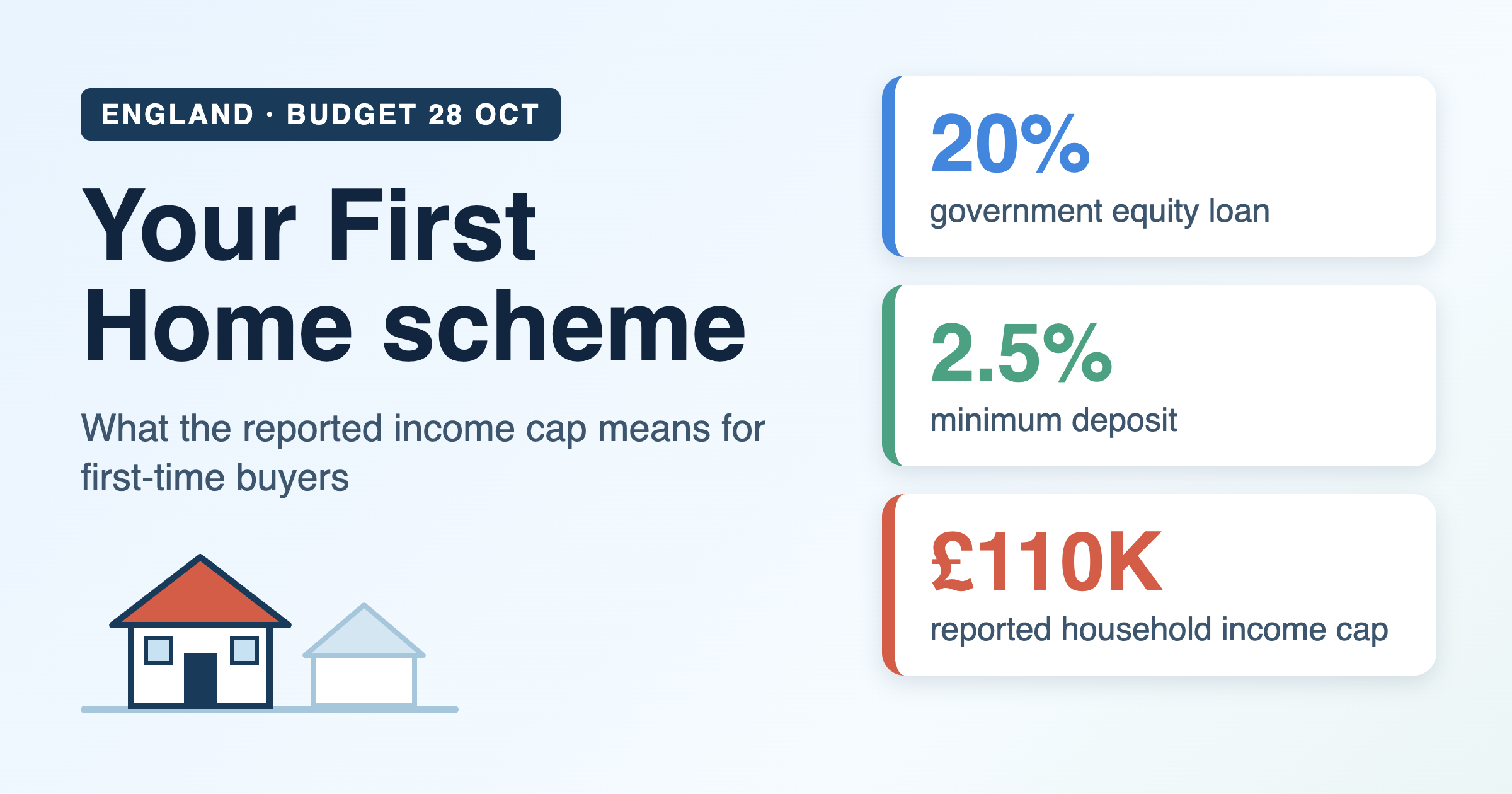
The short answer: the Your First Home scheme is a 20% government equity loan plus a deposit as low as 2.5%, for new-build homes in England. Also, the income cap is only a report from The Times so far. In fact, I think the price caps will decide more than the income cap, and I will explain why below.
Your First Home scheme: what is announced and what is only reported
GOV.UK announced the scheme on September 26. First, the table below separates the official parts from the reported parts, since the two get mixed up in headlines.
| Item | Detail | Status |
|---|---|---|
| Who can use it | First-time buyers in England | Announced |
| Which homes | New-builds from developers signed up to the scheme | Announced |
| Equity loan | 20% of the price, government-backed | Announced |
| Deposit | As low as 2.5% | Announced |
| Interest | Interest-free for an initial period, length not published | Announced, details missing |
| Income cap | £110,000 household, £140,000 for London homes | Reported by The Times, not confirmed |
| Price caps | Local limits on the home price, levels not published | Promised, levels unknown |
| Details and costs | Budget on October 28, registration by end of 2026 | Announced and reported |
The reported income cap: who it helps and who it leaves out
What the numbers say
According to the BBC, ministers first settled on £90,000 outside London and £110,000 in the capital. Then they decided that would shut out too many middle-earning couples, such as teachers and nurses. So the reported figures for the Your First Home scheme are £110,000 and £140,000.
Why a cap exists at all
Previous schemes had no income limit at all. In fact, the IFS found that Help to Buy helped higher earners the most, and that it made only a limited difference to housing affordability. So that explains why the government wants support aimed at people who “really need” it.
How I read the £110,000 figure
The reports describe a household limit, so two people earning £55,000 each sit right on the line. That is a decent income for England outside London, so the cap will not catch many single buyers. Still, a household cap means a couple with one high salary can drop out even if neither person feels wealthy. So I would wait for the exact wording, including whether it means gross pay before tax.
What the Your First Home scheme looks like in numbers
The Guardian used Rightmove’s average asking price for a first-time buyer home, £225,199. To compare, I ran the same price through both routes. For the monthly payments, I assumed a 5% rate over 25 years for both loans. However, that rate is my assumption, and in practice 95% deals often cost a bit more.
| Standard 95% mortgage | Your First Home | |
|---|---|---|
| Home price | £225,199 | £225,199 |
| Your deposit | £11,260 (5%) | £5,630 (2.5%) |
| Government equity loan | None | £45,040 (20%) |
| Mortgage needed | £213,939 | £174,529 (77.5%) |
| Monthly payment at 5%, 25 years | About £1,251 | About £1,020 |
That is roughly £230 a month less, and the equity loan has no interest at first. Still, the loan is not free money. Under the old Help to Buy rules, buyers repaid the same percentage of the home’s value at the time of sale, so a rising price raised the debt.
The thin cushion with a 2.5% deposit
Here is the part I did not see in the coverage. Because the equity loan shrinks when the home loses value, your equity is the home value minus 20% minus the mortgage. For example, on the numbers above, a price fall of about 3% leaves you with no equity at all. Still, this is my own calculation, and it ignores fees and the mortgage you pay off along the way. Also, the Your First Home scheme may repay differently, since this assumes repayment works like Help to Buy, which has not been confirmed. Even so, it shows why Charlie Lamdin argues in Mortgage Introducer that a 2.5% deposit leaves buyers more exposed to negative equity.
What happens when the interest-free period ends
However, the Your First Home scheme has not published this. For reference, the old Help to Buy loan charged nothing for five years. In year six it charged 1.75% of the original loan, and the rate rose each April by CPI plus 2%. So on £45,040, 1.75% is about £788 a year, or roughly £66 a month. Treat that as the old rule, because the new terms could differ.
Why price caps may matter more than the income cap
Savills analysis, reported by Mortgage Introducer, looked at what happened under Help to Buy’s regional caps. First, the caps used regional averages, and averages hide big local gaps. As a result, buyers in pricier towns had nothing they were allowed to buy, while cheaper towns in the same region were fine.
| Area | Typical three-bed new-build | Help to Buy cap (2021 to 2023) |
|---|---|---|
| Epping Forest (East of England) | About £650,000 | £407,400 |
| Ipswich (East of England) | £362,450 | £407,400 |
| Bournemouth (South West) | £465,000 | £349,000 |
| Forest of Dean (South West) | £334,995 | £349,000 |
Savills also tested flat limits. For example, a £300,000 cap across England would bring a three-bed new-build within reach in only 10% of local authorities, and £350,000 would raise that to 58%. Also, 55 local authorities would need a cap above £600,000 for any three-bed home to qualify.
Because of that, I care more about the price caps than the £110,000 figure. First, an income cap is simple to check, since you know your own pay. However, a price cap decides whether any home near you counts, and families who want a house rather than a flat look most exposed. Meanwhile, Rightmove estimates that the share of new-builds affordable to an average solo buyer would rise from about 10% to 22%, so the Your First Home scheme still opens a lot of doors.
How the Your First Home scheme compares with Help to Buy
The Guardian calls the Your First Home scheme an updated version of Help to Buy, and the table shows why. However, the differences are where the money is.
| Feature | Help to Buy (2021 to 2023) | Your First Home (as announced) |
|---|---|---|
| Equity loan | 20%, up to 40% in London | 20% everywhere |
| Minimum deposit | 5% | 2.5% |
| Interest-free period | 5 years | “Initial period”, length unknown |
| Income cap | None | Reported £110,000 (£140,000 London) |
| Price caps | Regional, £186,100 in the North East to £600,000 in London | Local caps promised, levels unknown |
| Property type | New-build | New-build |
Also, London buyers lose the most here. Help to Buy offered up to 40% there, while the Your First Home scheme offers 20% wherever you live. Then again, the Guardian notes that Help to Buy helped 328,000 first-time buyers, and a government review found it delivered very high value for money. Still, critics said it pushed up prices and boosted builders’ profits, and housebuilder shares jumped after the announcement, with Persimmon closing 14.7% higher on September 28. So I take that as a signal that the market expects developers to gain too.
What we still do not know about the Your First Home scheme
- How long the equity loan stays interest-free, and what it costs afterwards
- Whether you can repay it early, and what happens if you sell or struggle with payments
- The local price caps and the final income limit
- The size of the London loan
- How much new-build supply exists where you want to live
- Whether the scheme opens to existing homes, which some industry groups have asked for
What I would do before the Your First Home scheme details land
Still, this is my own suggestion, not official advice. First, do not pay a reservation fee on a new-build because of the Your First Home scheme until the Budget confirms the rules. Also, add up your household income before tax, so you know which side of the cap you land on. Then, ask the developer whether it plans to sign up, because the Your First Home scheme only works with participating developers. Finally, ask a broker to price a 77.5% loan-to-value mortgage next to a 95% one, since that comparison drives the real saving.
Quick answers
Is the £110,000 income cap official?
No. The BBC says the limits are expected to be confirmed at next week’s Budget, and the figure comes from The Times.
Can I use the Your First Home scheme to buy an older house?
Also, based on the announcement, no. It covers new-builds from developers signed up to the scheme, although some industry groups want it extended to existing homes.
Does the Your First Home scheme cover Scotland, Wales or Northern Ireland?
Also, no, it is for England only. However, the Guardian says it is unclear whether the devolved governments will run their own versions.
When can I apply?
Pre-registration is expected to open before the end of 2026, according to Mortgage Introducer, and the Budget on October 28 should set out the timeline.
Meanwhile, if you follow other UK household money changes, our Warm Home Discount guide covers who gets the £150 this winter.
The short version
The Your First Home scheme gives first-time buyers in England a 20% equity loan and a deposit as low as 2.5% on new-builds, with a reported income cap of £110,000 (£140,000 in London) that the October 28 Budget should confirm. Meanwhile, the price caps and the interest-free period are still unknown, so hold off on any commitment until the details are official.